




Helium Abundance
Tracing solar wind origins through composition
Helium abundance in the solar wind varies dramatically with speed, rising from near-zero in the slowest wind to a saturation value of 4.19% above 433 km/s. This compositional fingerprint, locked in at the chromosphere, provides a powerful diagnostic for distinguishing solar wind from source regions with intermittently and continuously open magnetic field topologies.
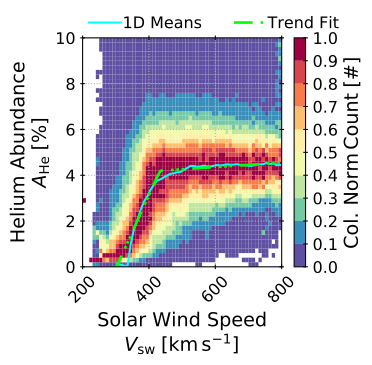
Helium abundance rises with speed then saturates
Related Figures
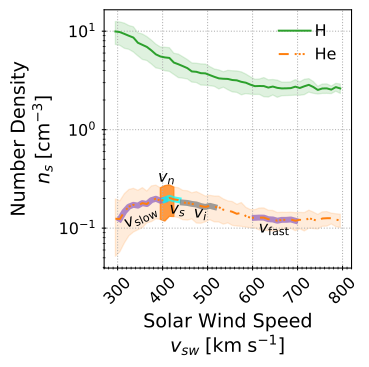
Helium density peaks near the closed-to-open source transition
While hydrogen density simply decreases with speed, helium density reaches a distinct peak at 409 km/s, right where the transition between closed and open magnetic source regions occurs.
Shows that helium density peaks at 409 km/s, right where the transition between closed and open magnetic source regions occurs, providing independent confirmation of the saturation-based source-region boundary
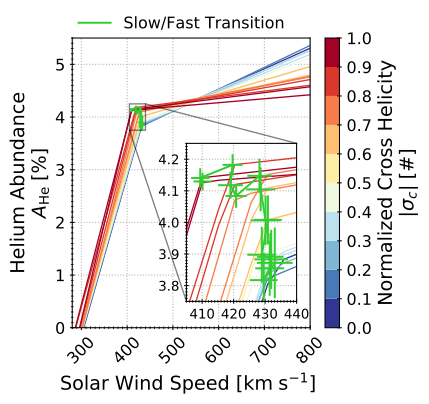
Higher wave activity shifts helium saturation to lower speeds
The speed at which helium saturates depends systematically on wave activity.
Demonstrates that the helium saturation point is not fixed but shifts systematically with Alfvénicity or cross helicity, revealing an unexpected enhancement in fast wind helium abundance when the Alfvénicity is low in fast wind. Alterman & D'Amicis (2025b, ApJL) resolves the contradiction implied by this observation.
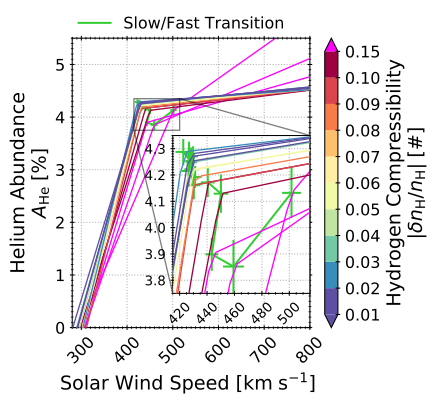
Compressible wind drives helium far above the plateau
When sorted by hydrogen density fluctuation level, two starkly different behaviors emerge above saturation.
Shows that compressibility, not Alfvénicity, is the primary regulator of helium saturation
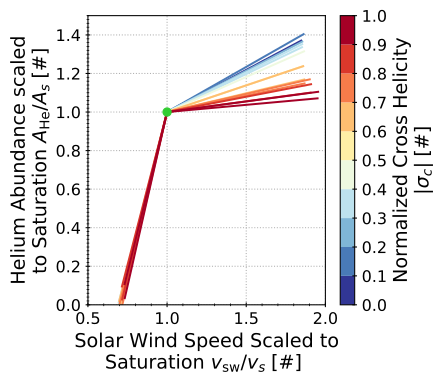
Helium depletion below saturation follows one universal curve
Rescaling reveals that helium depletion in slow wind follows a single universal process that is completely independent of wave activity.
Reveals that helium abundance follows a universal scaling law below saturation regardless of Alfvénicity, but diverges into Alfvénicity-dependent behavior above saturation
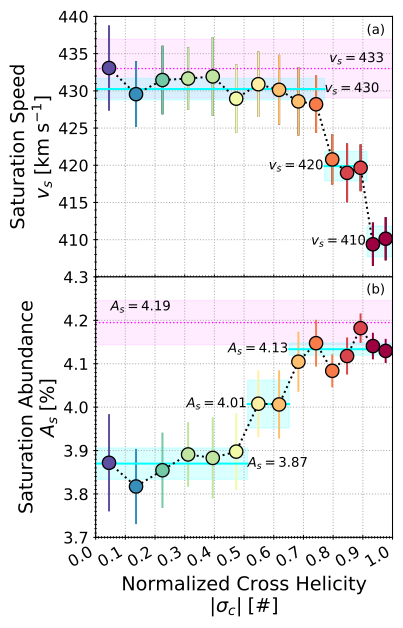
Saturation speed and abundance anticorrelate with wave activity
The saturation speed decreases by 23 km/s (from 433 to 410) while the saturation abundance increases by 0.26 percentage points (from 3.87% to 4.13%) as wave activity increases.
Quantifies the anticorrelation between saturation speed and saturation abundance as a function of Alfvénicity, providing the key empirical relationship for understanding helium behavior
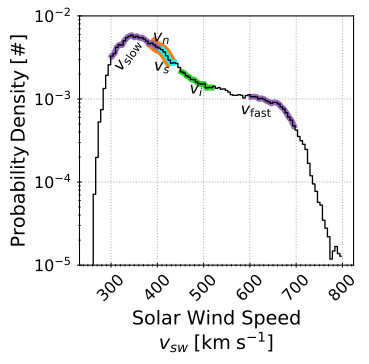
Five characteristic speeds span the fast/slow transition zone
The five characteristic speeds derived throughout this paper map onto consecutive portions of the solar minimum speed distribution.
Maps all five characteristic speeds onto the wind speed distribution, revealing that the fast/slow boundary is not a single threshold but a sequence of overlapping helium-related transitions spanning ~130 km/s
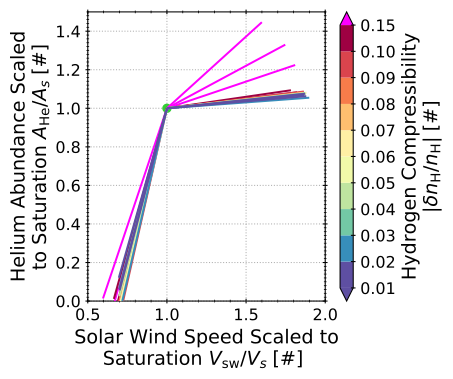
Incompressible curves collapse onto a universal shape
When each curve is normalized to its own saturation point, the incompressible curves collapse onto a single universal shape.
Demonstrates that limiting compressibility < 15% excludes confounding impacts and enables reliable source region identification
See Also
Source
Cross Helicity and the Helium Abundance as an In Situ Metric of Solar Wind Acceleration
The Astrophysical Journal Letters (2025)
View Paper© 2025 The Author(s). Published by the American Astronomical Society. CC BY 4.0