



Higher wave activity shifts helium saturation to lower speeds
What We See
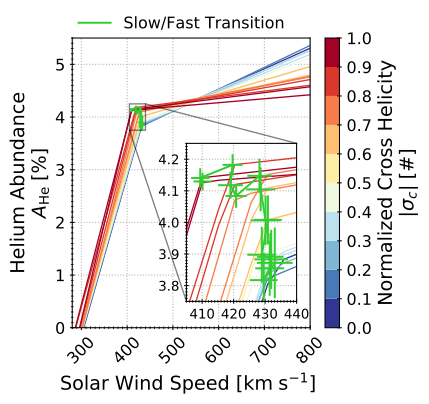
Fifteen colored lines trace helium abundance versus solar wind speed, colored from dark blue (lowest wave activity) through yellow to dark red (highest wave activity). Below about 430 km/s, all fifteen lines follow nearly the same steep upward path from zero. Above that speed, they fan apart: blue lines (low wave activity) continue rising while red lines (high wave activity) flatten out. Green data points with error bars mark each line's saturation point. An inset panel zooms into these green points, revealing they form a diagonal trend from lower-right (low wave activity: higher speed, lower abundance) to upper-left (high wave activity: lower speed, higher abundance).
The Finding
The speed at which helium saturates depends systematically on wave activity. In highly wave-like wind, helium reaches its maximum abundance (4.13%) at a lower speed (around 410 km/s). In wind with little wave activity, saturation occurs at a higher speed (around 430 km/s) and lower abundance (3.87%). This anticorrelation means the boundary between open and closed magnetic sources shifts with Alfvenicity. The identical slopes below saturation across all wave levels show that the process depleting helium in closed-field slow wind is independent of Alfven waves.
Why It Matters
This figure provides the key evidence for explaining the Alfvenic slow wind. Because the saturation speed is lower for more wave-like wind, there is a range of speeds (roughly 410-430 km/s) where wind from open magnetic regions overlaps with wind from closed regions. This overlap is the Alfvenic slow wind: it has slow speeds but carries helium abundance and wave activity typical of fast wind from open field regions. The universal slope below saturation constrains theoretical models of helium depletion.
Appears In
Alterman 2025 ApJL 982 L40 · fig 5