




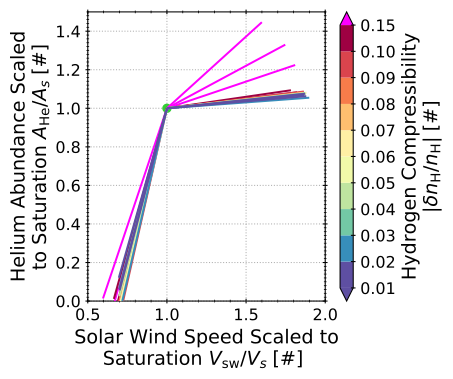
Incompressible curves collapse onto a universal shape
What We See
Fifteen helium-speed curves, one per compressibility bin, are rescaled so that each saturation point sits at coordinates (1, 1). Below saturation (left of the green marker), all curves nearly overlap, forming a tight bundle regardless of compressibility level. Above saturation (right of the green marker), the incompressible curves remain tightly bundled near a flat line at 1.0, while the compressible curves (pink) splay upward, diverging sharply from the universal pattern.
The Finding
When each curve is normalized to its own saturation point, the incompressible curves collapse onto a single universal shape. The helium-speed relationship below saturation follows the same functional form regardless of compressibility, with only the saturation point shifting. Above saturation, universal behavior breaks only for compressible wind. This collapse confirms that a single physical process governs helium in incompressible wind, while compressible fluctuations introduce a separate, additional process that drives helium above saturation.
Why It Matters
Universal scaling in physics signals underlying simplicity in the governing process. The collapse of incompressible curves suggests that helium abundance in non-compressible solar wind is controlled by a single mechanism depending only on the saturation parameters. This simplification could enable more accurate models of helium distribution in the solar wind, improving predictions of chemical composition near Earth.
Appears In
Alterman 2026 ApJL 996 L12 · fig 10