




Helium density peaks near the closed-to-open source transition
What We See
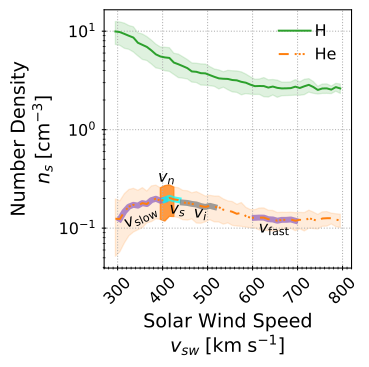
A logarithmic chart shows hydrogen (solid green line) and helium (orange dash-dot line) particle density versus solar wind speed from 300 to 800 km/s. Semitransparent bands show standard deviations. Hydrogen decreases monotonically from about 10 to 2.6 particles per cubic centimeter. Helium rises from about 0.12 to a peak of 0.2 near 409-415 km/s, then decreases to about 0.12 at the fastest speeds. Color-coded segments highlight key speed ranges on the helium line: purple for the slow and fast wind peaks (v_slow, v_fast), orange for the helium density peak (v_n), cyan for the saturation speed range (v_s), and gray for the Gaussian intersection speed (v_i).
The Finding
While hydrogen density simply decreases with speed, helium density reaches a distinct peak at 409 km/s, right where the transition between closed and open magnetic source regions occurs. This peak falls within the range of saturation speeds derived across wave-activity quantiles. The close clustering of v_slow, v_n, v_s, and v_i within a narrow speed interval (355-484 km/s) indicates that multiple physical transitions overlap in this range, suggesting the traditional fast/slow boundary is not a single threshold but a complex transition zone.
Why It Matters
The helium density peak provides independent confirmation of the source-region transition identified by the saturation analysis. It suggests that maximum helium loading into the solar wind occurs precisely where closed-field sources give way to open-field sources. Above this speed, helium density falls along with hydrogen, consistent with helium acting as a simple additional mass term in open-field wind. This constrains models of how the Sun's corona partitions energy between hydrogen and helium during solar wind acceleration.
Appears In
Alterman 2025 ApJL 982 L40 · fig 8