




Saturation speed and abundance anticorrelate with wave activity
What We See
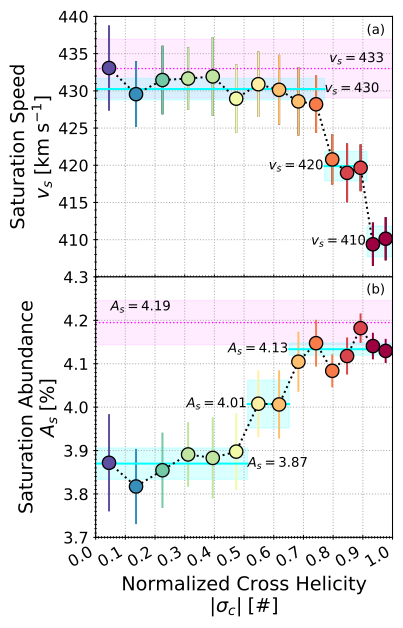
Two vertically stacked panels share a horizontal axis showing wave activity from 0 to 1. In panel (a), fifteen colored dots with error bars show saturation speed (vertical axis, 407-440 km/s). The dots stay near 430 km/s at low wave activity then drop to about 410 km/s at the highest wave activities. A pink dotted line and shaded band at 433 km/s mark the all-data value. Cyan horizontal bands group the points into three distinct levels: 430, 420, and 410 km/s. In panel (b), the dots show saturation abundance (vertical axis, 3.7-4.3%), rising from about 3.87% to 4.13% with increasing wave activity, again grouped by cyan bands at three levels.
The Finding
The saturation speed decreases by 23 km/s (from 433 to 410) while the saturation abundance increases by 0.26 percentage points (from 3.87% to 4.13%) as wave activity increases. Both quantities show three distinct plateaus rather than smooth variation, suggesting step-like transitions between regimes. This anticorrelation means the boundary between open and closed magnetic source regions shifts systematically: more wave-like wind saturates at lower speed but higher helium, directly quantifying how the open/closed transition depends on Alfvenicity.
Why It Matters
The 23 km/s shift in saturation speed between non-Alfvenic and highly Alfvenic wind defines a speed interval (410-433 km/s) where wind classification is ambiguous based on speed alone. This quantitative measurement is the foundation for the paper's proposed classification scheme using helium and wave activity together. The three-plateau structure in both panels may reflect distinct physical regimes in how the solar corona accelerates the wind, constraining future theoretical models.
Appears In
Alterman 2025 ApJL 982 L40 · fig 7