




Compressible wind drives helium far above the plateau
What We See
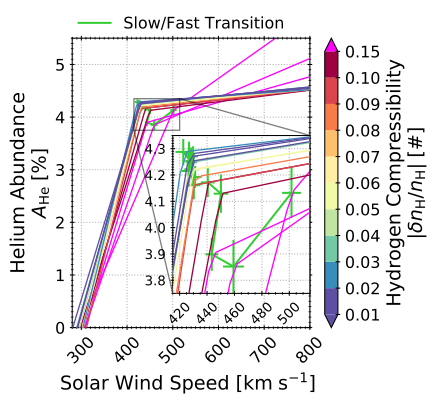
Fifteen colored lines trace how helium abundance (vertical axis) changes with solar wind speed (horizontal axis), each representing a different compressibility level from low (dark blue) to high (pink). All lines rise steeply at slow speeds, but they diverge sharply above the saturation point where green markers sit. The incompressible lines (cool colors) flatten into a near-horizontal plateau. The compressible lines (pink, above 0.15) continue rising steeply, reaching helium levels well above the plateau. An inset zooms into the saturation region.
The Finding
When sorted by hydrogen density fluctuation level, two starkly different behaviors emerge above saturation. Incompressible wind with fluctuations below about 15 percent behaves as expected for open-source fast wind: helium reaches a constant plateau. Compressible wind with fluctuations above 15 percent continues accumulating helium with increasing speed, reaching levels well above the plateau. Below saturation, all curves have indistinguishable gradients regardless of compressibility, confirming that the slow-wind helium process is independent of density fluctuations.
Why It Matters
Compressible fluctuations resolve the helium paradox by showing that compressible fluctuations, not a failure of the source-region classification, explain why some fast wind carries more helium than expected. The clean separation between compressible and incompressible behavior reveals hydrogen compressibility as a fundamental regulator of helium abundance in the solar wind.
Appears In
Alterman 2026 ApJL 996 L12 · fig 9