



Helium depletion below saturation follows one universal curve
What We See
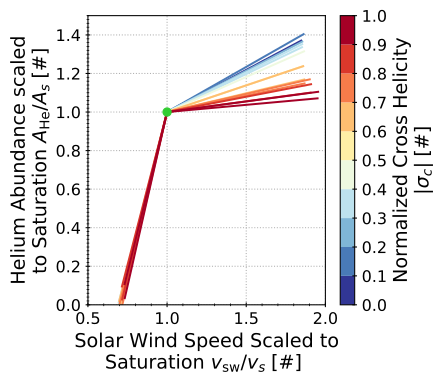
Fifteen helium-versus-speed curves, one per wave-activity bin, are rescaled so each curve's saturation point maps to the coordinate (1, 1), marked by a green dot. Both axes are dimensionless ratios: speed divided by saturation speed on the horizontal axis, and helium abundance divided by saturation abundance on the vertical axis. Below (1, 1), all fifteen lines collapse onto a single overlapping curve regardless of color. Above (1, 1), the lines separate: dark blue lines (low wave activity) rise steeply while dark red lines (high wave activity) remain nearly flat.
The Finding
Rescaling reveals that helium depletion in slow wind follows a single universal process that is completely independent of wave activity. All fifteen wave-activity groups produce an identical curve below the saturation point, meaning the physics setting helium abundance in closed-field source regions does not involve Alfven waves. Above saturation, wave activity matters: the more wave-like the wind, the flatter the helium trend, consistent with helium being freely accelerated alongside hydrogen in open field regions where waves provide additional acceleration energy.
Why It Matters
The collapse of all curves below saturation into one universal shape provides a strong constraint for theoretical models of slow wind formation. Any viable model must produce helium depletion that does not depend on wave activity. This likely reflects gravitational settling or collisional energy transfer from helium to hydrogen in closed magnetic loops, governed by the loop's thermal structure rather than wave-particle interactions. Above saturation, the wave-dependent behavior constrains open-field acceleration models.
Appears In
Alterman 2025 ApJL 982 L40 · fig 6