




Solar Wind Acceleration
How magnetic waves shape solar wind speeds
Alfven waves propagating through the solar wind continuously deposit energy into the plasma, accelerating it during its journey from the Sun to Earth. Speed distributions reveal that fast solar wind receives an additional 100+ km/s boost from wave forcing, explaining why observed speeds exceed predictions from thermal expansion alone.
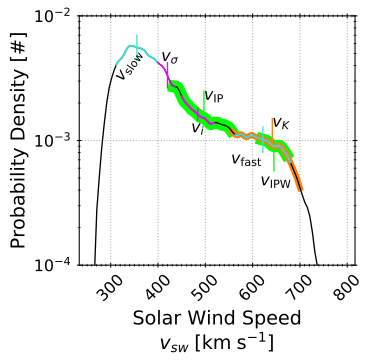
Alfven wave forcing explains the fastest solar wind at Earth
Related Figures
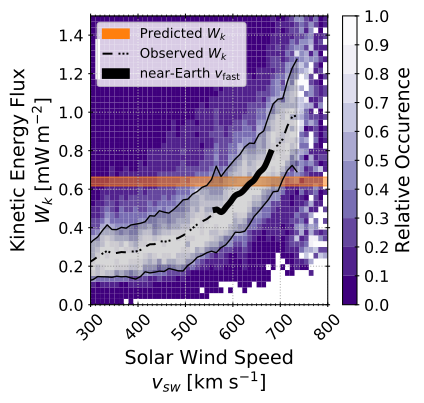
Near-Sun energy predicts near-Earth fast wind speeds
Kinetic energy flux increases steadily with solar wind speed, and the horizontal orange band — derived from scaling near-Sun Parker Solar Probe energy measurements outward using empirically determined power laws — intersects the observed trend at speeds of 557-700 km/s.
Demonstrates how kinetic energy measured near the Sun by Parker Solar Probe predicts speeds at Earth, validating that wave-driven acceleration is complete by 0.2 AU
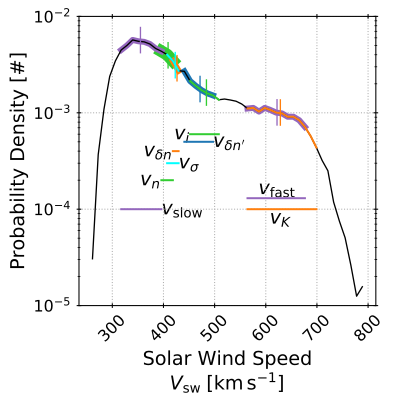
Derived speeds map onto the bimodal wind distribution
Characteristic speeds from compressibility analysis (this paper), wave activity analysis (companion paper), and independent energy budget studies all map onto distinct, physically meaningful portions of the bimodal speed distribution.
Places characteristic speeds from compressibility, wave activity, and energy budget analyses onto the bimodal speed distribution, showing how multiple independent approaches converge on a consistent picture of where wave-driven acceleration shapes the wind
See Also
Source
Characterizing the Impact of Alfven Wave Forcing in Interplanetary Space on the Distribution of Near-Earth Solar Wind Speeds
The Astrophysical Journal Letters (2025)
View Paper© 2025 The Author(s). Published by the American Astronomical Society. CC BY 4.0