




Near-Sun energy predicts near-Earth fast wind speeds
What We See
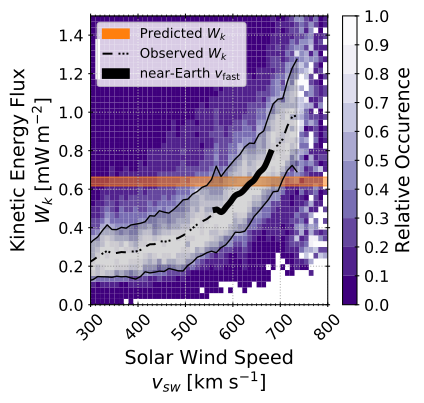
A two-dimensional heatmap plots kinetic energy flux (vertical axis, 0 to 1.4 milliwatts per square meter) against solar wind speed (horizontal axis, about 300 to 800 km/s). The color scale runs from deep purple (few observations) through lavender to white (most common value at each speed); each column is independently normalized so the most frequent energy value appears white regardless of how often that speed occurs. A black dash-dotted line traces the peak energy flux at each speed, flanked by solid black lines marking the spread. A thick black segment on the central trend highlights the fast wind speed range. A horizontal orange band at approximately 0.62-0.66 mW/m^2 stretches across the full width, marking the kinetic energy flux predicted from near-Sun Parker Solar Probe measurements.
The Finding
Kinetic energy flux increases steadily with solar wind speed, and the horizontal orange band — derived from scaling near-Sun Parker Solar Probe energy measurements outward using empirically determined power laws — intersects the observed trend at speeds of 557-700 km/s. This intersection falls precisely on the fast wind peak. The match demonstrates that the energy budget measured close to the Sun is sufficient to account for the kinetic energy carried by the fastest nontransient solar wind observed at Earth, without requiring any additional unaccounted energy source. Above 740 km/s the data become too sparse during the declining phase of solar activity for reliable fitting, but the key intersection occurs well below that threshold.
Why It Matters
This figure bridges the observational gap between the inner heliosphere and Earth's orbit. Parker Solar Probe measures the solar wind's energy near the Sun, but the scientific question is whether that energy can explain conditions at Earth. By demonstrating that the predicted and observed kinetic energy fluxes converge at fast wind speeds, this analysis validates the use of inner-heliosphere measurements for predicting near-Earth solar wind properties. This is a key step toward improving space weather forecasting, which relies on connecting remote and in situ observations across very different distances from the Sun.
Appears In
Alterman 2025 ApJL 984 L64 · fig 2