



Coulomb Collisions
How particle collisions shape solar wind evolution
Coulomb collisions act as friction on solar wind ions, gradually reducing the differential flows of alpha particles and proton beams during their journey from Sun to Earth. By extrapolating measured drifts to zero collisional age, we reveal the intrinsic velocity limits set by wave-particle interactions in the corona.
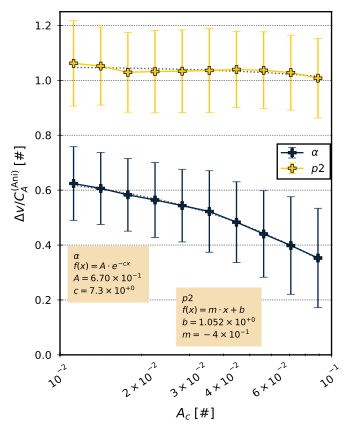
Extrapolated drift speeds reveal coronal launch conditions
Related Figures
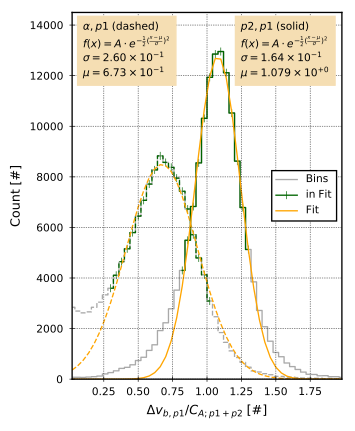
Proton beams drift faster than alphas relative to the Alfven speed
In fast, nearly collisionless solar wind, proton beams consistently drift about 60% faster than alpha particles relative to the main proton population.
Establishes the baseline observation that drifts cluster at characteristic Alfven speed fractions, motivating the collisional age analysis
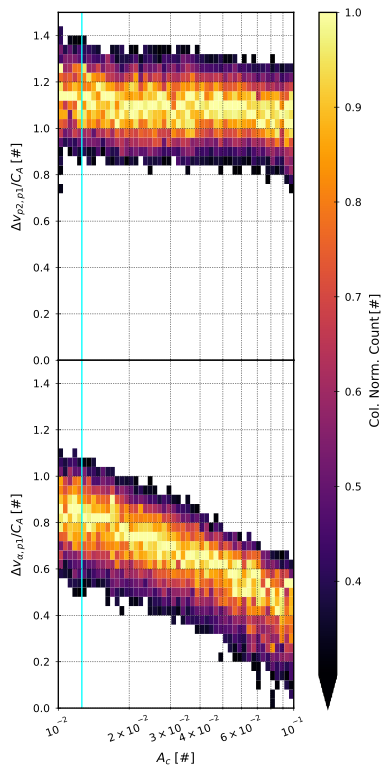
Alpha drift fades with collisions while beam drift persists
Alpha particle drift speed drops dramatically -- from about 80% to 40% of the Alfven speed -- as collisional age increases across the measured range.
Demonstrates the core finding that collisions dramatically slow alpha drift while leaving beam drift unchanged
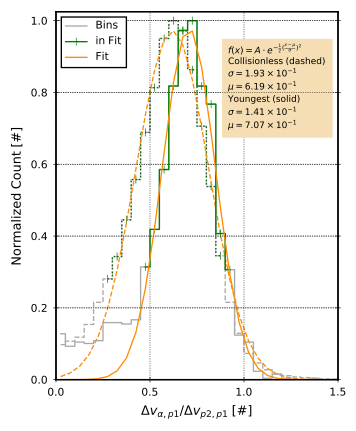
Alpha-to-beam speed ratio sharpens in youngest plasma
In the youngest, most collisionless solar wind measured at Earth, alpha particles drift at about 71% the speed of proton beams, compared to 62% when a broader range of weakly collisional data is included.
Shows that restricting to youngest plasma narrows the alpha-to-beam ratio, confirming collisional age as a major source of scatter
See Also
Source
A Comparison of Alpha Particle and Proton Beam Differential Flows in Collisionally Young Solar Wind
The Astrophysical Journal (2018)
View Paper© 2018 American Astronomical Society. CC BY 3.0