




Slow-wind heavy element abundances dip at solar minimum
What We See
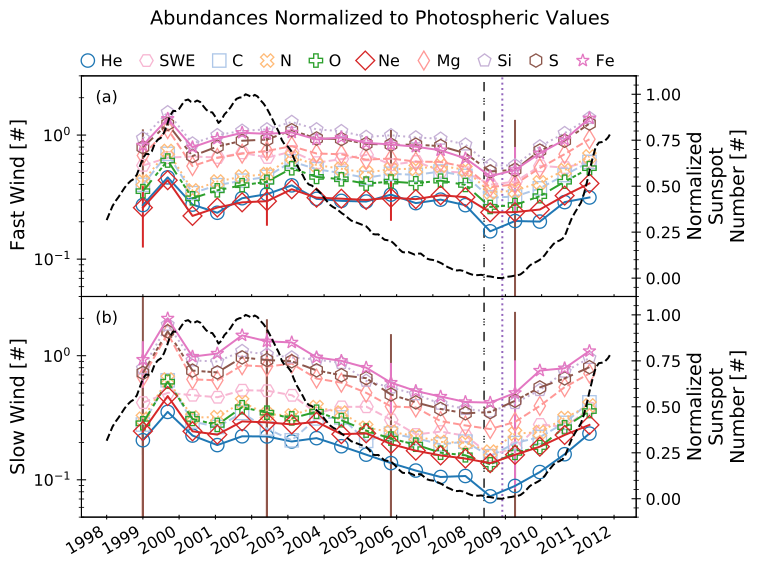
Two panels spanning 1998–2012 track nine element abundances (He through Fe) relative to their photospheric values on a logarithmic vertical scale. Panel (a) shows fast wind; panel (b) shows slow wind. Each colored line and symbol represents a different element, with low ionization-potential species like iron (pink stars) and magnesium (pink diamonds) sitting highest and high ionization-potential species like helium (blue circles) and oxygen (green crosses) sitting lowest. A dashed black curve traces the normalized sunspot number on the right axis. Vertical lines mark solar minimum 24 (dotted brown) and the helium shutoff (dash-dotted black). Pink pentagon markers plot SWE helium for cross-validation with SWICS.
The Finding
In the slow wind, all heavy element abundances except carbon track the solar cycle strongly, dropping during the deep solar minimum around 2008–2009 and recovering as activity rises. The depletion is visible across the full range of measured species, from nitrogen to iron. In the fast wind, abundances remain comparatively stable, consistent with origination from steadily open magnetic regions whose properties do not change dramatically with the cycle. The timing of the abundance minimum appears closer to the helium shutoff event than to the official sunspot minimum, suggesting these depletions share a common physical origin in the Sun's lower atmosphere.
Why It Matters
This is the first systematic characterization of how nine heavy element abundances evolve with the solar cycle when separated by source region type using each element's saturation speed. The contrast between fast and slow wind confirms that the two populations originate from fundamentally different magnetic environments—continuously open versus intermittently open field lines. The low-FIP/high-FIP (first ionization potential) stratification visible across both panels reflects fractionation processes in the chromosphere and transition region. The near-coincidence of abundance minima with the helium shutoff suggests that a process deep in the solar atmosphere drives the depletion of all species simultaneously.
Appears In
aa54299-25 · fig 2