



A new classification maps solar wind to its magnetic source
What We See
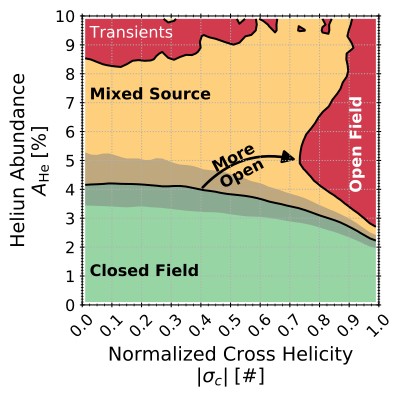
A cartoon diagram divides the wave activity (horizontal axis, 0-1) versus helium abundance (vertical axis, 0-10%) plane into four labeled regions using black contour boundaries. A large green region labeled 'Closed Field' fills the bottom of the plane up to about 4.2% helium. A red region labeled 'Open Field' occupies the right edge at high wave activity. A yellow-orange region labeled 'Mixed Source' fills the middle. A small red region labeled 'Transients' sits in the upper left corner. A gray band across the lower boundary of the Mixed region marks the full range of saturation speeds. A curved arrow labeled 'More Open' in the Mixed region points toward the Open Field boundary.
The Finding
This classification scheme distills the quantitative contour analysis into a practical map of solar wind source regions. Wind with low helium (below about 4.2%) at any wave activity likely originates from magnetically closed regions like helmet streamers. Wind with high wave activity (above 0.73) and moderate helium likely comes from magnetically open regions like coronal holes. The broad middle region represents mixed observations where both source types contribute. Within the mixed region, higher wave activity increases the likelihood of an open field origin, as indicated by the arrow.
Why It Matters
This classification scheme is the central practical result of the paper. It identifies solar wind source regions using only helium abundance and cross helicity, without requiring a mass spectrometer for elemental or charge-state composition. Most heliophysics spacecraft carry plasma instruments capable of these measurements, making this scheme widely applicable. It directly addresses the first of nine outstanding questions in solar wind physics identified by Viall and Borovsky: from where on the Sun does the solar wind originate?
Appears In
Alterman 2025 ApJL 982 L40 · fig 11