




Space Weather
Mapping solar wind to its source on the Sun
Space weather forecasting requires knowing where solar wind originated on the Sun. By combining helium abundance and cross helicity measurements, we can classify solar wind into distinct source-region types and predict its impact on Earth's magnetosphere.
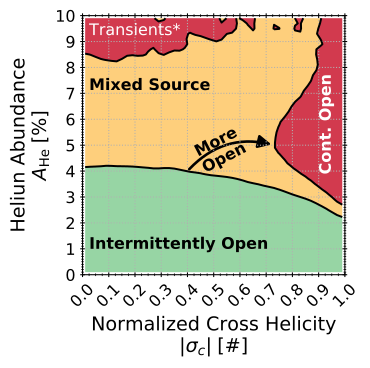
Three-parameter map classifies solar wind by origin
Related Figures
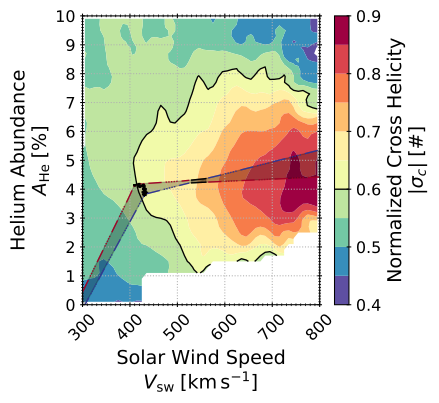
Wave activity maps onto the helium-speed plane
The saturation points consistently fall in the region of moderately high wave activity, above the 0.6 contour.
Demonstrates the universal scaling behavior that underlies the classification scheme
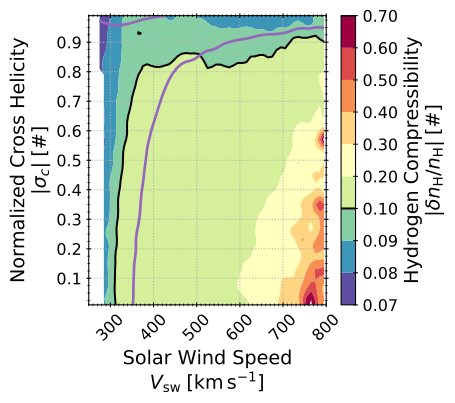
Compressibility and wave activity are inversely related
Compressibility and wave activity are inversely related across the speed-wave activity plane.
Shows how helium abundance varies with cross helicity in different solar wind classification regimes
See Also
Helium abundance is a key parameter in the classification scheme
Cross helicity (Alfvénicity) is the other key parameter in the classification
Compressibility refines the classification boundaries
The classification scheme maps solar wind back to its coronal source regions
Source
On the Regulation of the Solar Wind Helium Abundance by the Hydrogen Compressibility
The Astrophysical Journal Letters (2026)
View Paper© 2026 The Author(s). Published by the American Astronomical Society. CC BY 4.0