




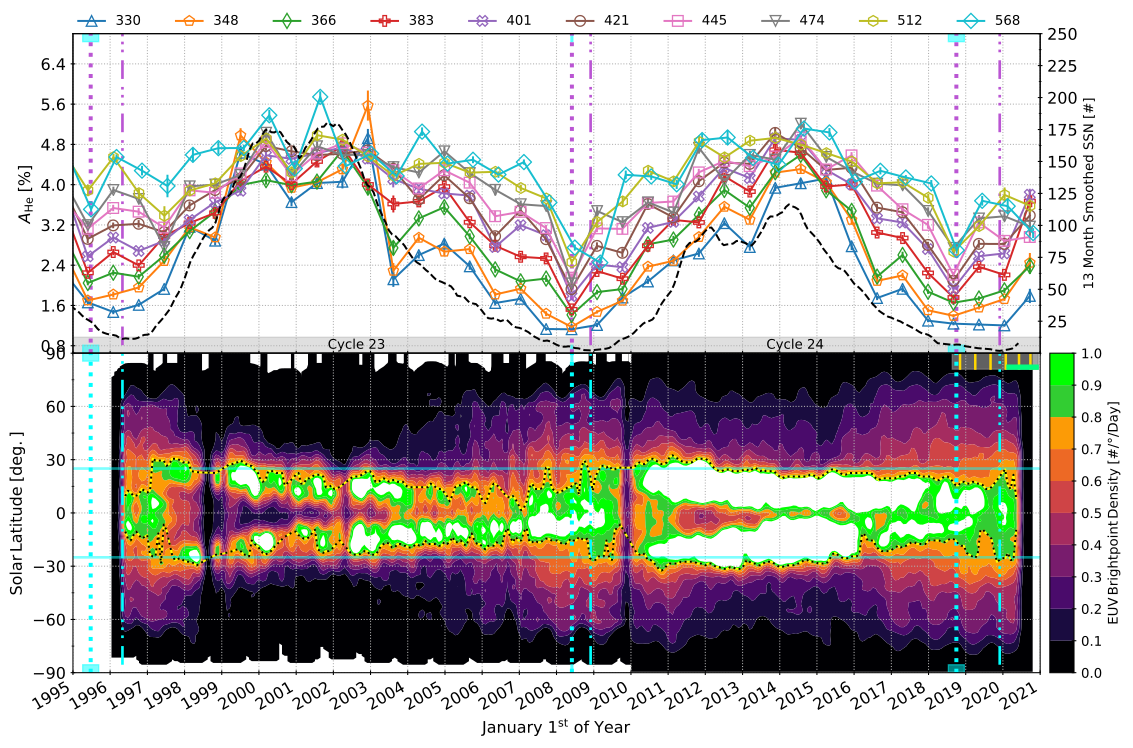
Helium shutoff coincides with new-cycle magnetic emergence
What We See
The top panel shows solar wind helium abundance at different wind speeds for 1995-2021, covering Cycles 23 and 24. Ten colored lines track helium abundance at different wind speeds; a dashed black curve shows sunspot number. Vertical cyan and magenta lines mark solar minima and helium shutoffs. The bottom panel shows a filled contour map of EUV brightpoint density versus solar latitude and time. Green, orange, and white contours sweep from mid-latitudes toward the equator over each cycle, forming the classic butterfly pattern. A dotted yellow-black line traces the 0.8 density threshold. Semitransparent blue lines mark latitudes of plus and minus 25 degrees. A gray band and colored bars indicate Parker Solar Probe encounters and Solar Orbiter's launch.
The Finding
Helium shutoff occurs at approximately the same time that new-cycle brightpoints emerge at mid-latitudes, particularly in the hemisphere that leads the new cycle. For Cycle 24, brightpoints appeared first in the northern hemisphere; for Cycle 25, the southern hemisphere led. This temporal coincidence connects an in-situ solar wind measurement (helium composition near Earth) with a remote observation of the Sun's surface (EUV brightpoints), suggesting both respond to the same underlying event. That event is the cancelation of the old cycle's magnetic flux at the equator and the emergence of the new cycle's toroidal magnetic bands.
Why It Matters
This connection between solar wind composition and the Sun's magnetic butterfly pattern provides a physical explanation for why helium signals the new cycle early. It ties a quantity measured near Earth to fundamental processes in the Sun's magnetic dynamo, specifically the death of one extended cycle's equatorial flux bands and the rise of the next. As Parker Solar Probe and Solar Orbiter explore ever closer to the Sun, they can test this connection directly, potentially revealing how deep magnetic restructuring propagates outward to change the solar wind composition we detect at Earth.
Appears In
s11207-021-01801-9 · fig 6