




Correlation with solar activity grows with element mass
What We See
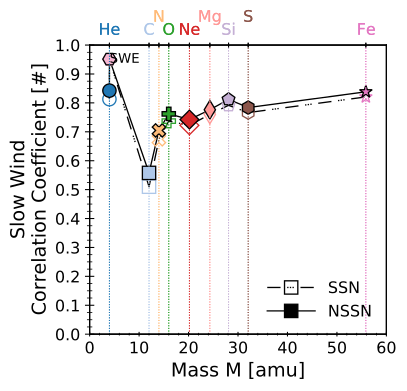
Each element's slow-wind correlation coefficient with solar activity is plotted against its atomic mass, from helium (~4 amu) on the left to iron (~56 amu) on the right. Open markers connected by a dash-dotted line show correlations computed with the standard sunspot number (SSN); filled markers connected by a solid line use the normalized sunspot number (NSSN). Element labels in matching colors run along the top axis, with vertical dotted lines linking each label to its data point. A separate marker near helium's mass labeled 'SWE' shows the Wind Faraday cup measurement, sitting above the SWICS helium point. From carbon through iron, correlation coefficients climb steadily upward.
The Finding
For elements heavier than helium, the correlation between slow-wind abundance and solar activity rises monotonically with atomic mass—from carbon (~0.51–0.56) to iron (~0.82–0.84). This mass-dependent trend is a signature of gravitational settling: heavier elements sink faster in closed magnetic loops, so their abundances are more sensitive to how long those loops persist. Helium breaks this pattern, sitting well above the trend with a correlation as strong as iron's despite being the lightest element measured. This anomaly signals an additional process—helium's dynamic role in solar wind acceleration—that does not couple to heavier species.
Why It Matters
This figure provides the clearest observational evidence that gravitational settling shapes the composition of slow solar wind from intermittently open source regions. The monotonic mass trend distinguishes gravitational settling from other fractionation processes like the FIP (first ionization potential) effect, which would produce a different ordering. Helium's departure from the trend constrains models of solar wind acceleration by requiring a mechanism that preferentially involves helium but not heavier ions. The consistently stronger correlations using the normalized sunspot number confirm that the sunspot count is a timing indicator for the solar cycle, not a direct physical driver of composition changes.
Appears In
aa54299-25 · fig 3