



Charge state organizes fast wind fractionation into a tight trend
What We See
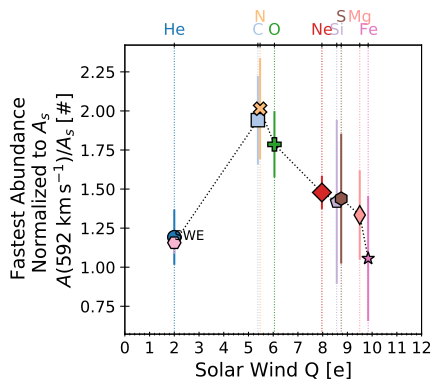
A scatter plot shows fast-wind abundance ratios for ten elements, plotted against each element's typical electrical charge in the solar wind. The horizontal axis spans 0 to 12 elementary charges; the vertical axis spans 0.75 to 2.25. Helium sits at charge +2 near 1.15. Carbon (blue square) and nitrogen (orange X) at charges +5 to +6 cluster near 2.0. Oxygen (green plus) at charge +6 reaches about 1.8. Moving to higher charges, neon and silicon near +8, sulfur near +9, and magnesium near +9 form a descending sequence from about 1.5 to 1.35. Iron at charge +10 sits near 1.05. A dotted black line connects the points, revealing a smooth, nearly linear decline from low to high charge state.
The Finding
The fast-wind fractionation correlates far more tightly with charge state than with mass, FIP, or mass-to-charge ratio, as measured by a robust coefficient of determination (R-squared of 0.95 for charge state versus below 0.55 for all other quantities tested). While mass orders the elements into three loose groups, charge state produces a smooth, nearly linear trend. This unexpected result suggests the unknown fractionation mechanism may couple to an element's electrical charge rather than its weight.
Why It Matters
This figure provides the strongest observational clue about what drives the mysterious fast-wind fractionation. A charge-state dependence is unexpected, and the authors note they do not yet have a physical explanation for it. The tight correlation significantly narrows the space of possible physical mechanisms and will guide future theoretical work on understanding how the solar wind's composition is modified during its acceleration from the Sun to Earth.
Appears In
aa51550-24 · fig 8