




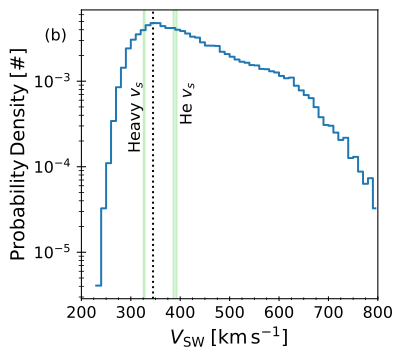
Heavy and helium transition speeds bracket the most common wind
What We See
A stepped blue histogram on a logarithmic vertical scale shows the probability density of solar wind speed observations, spanning roughly 200 to 800 km/s. The distribution peaks sharply near 345 km/s and drops off on both sides, with a long tail toward higher speeds. Two pairs of semitransparent green vertical lines mark the transition speeds and their uncertainties: one labeled 'Heavy vs' near 327 km/s on the rising side of the peak, and another labeled 'He vs' near 390 km/s on the falling side. A dotted black vertical line at 345 km/s marks the peak, sitting squarely between the two transition speeds.
The Finding
The heavy-element transition speed sits just below the most commonly observed solar wind speed, while helium's transition speed sits above it. The two boundaries bracket the peak of the speed distribution, meaning the most frequently measured solar wind falls between them. Any single speed threshold chosen between 327 and 402 km/s classifies a substantial fraction of observations differently depending on whether helium or heavier elements serves as the guide.
Why It Matters
The mismatch between helium and heavy-element transition speeds has practical consequences for a large fraction of solar wind observations. Scientists trying to trace the solar wind back to its source on the Sun will misclassify the origin of the most commonly observed wind speeds if they use the wrong transition speed. The figure makes the stakes of the paper's findings immediately visible and concrete.
Appears In
aa51550-24 · fig 7