




Fast wind reveals an unexplained mass-dependent fractionation
What We See
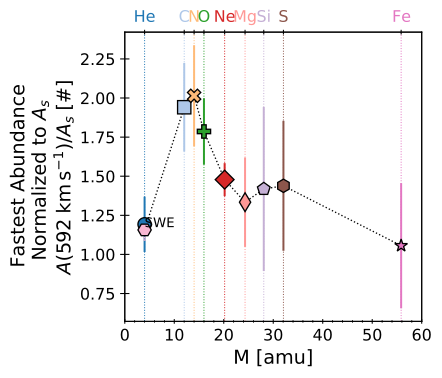
A scatter plot shows how much each element's abundance at the fastest observed speed (592 km/s) exceeds its transition-point abundance, plotted against element mass in atomic mass units. The horizontal axis spans 0 to 60 amu; the vertical axis spans 0.75 to 2.25. Helium and SWE sit at mass 4 near 1.15. Carbon (blue square, mass 12) and nitrogen (orange X, mass 14) cluster near 2.0. Oxygen (green plus, mass 16) reaches about 1.8. Neon (red diamond, mass 20) is near 1.5. Magnesium (pink diamond, mass 24) sits near 1.35. Silicon (purple pentagon, mass 28) and sulfur (brown hexagon, mass 32) are near 1.4. Iron (pink star, mass 56) barely exceeds 1.05. A dotted line connects the points, and colored vertical bars show error ranges, which are largest for silicon and iron.
The Finding
In fast solar wind, lighter heavy elements are enhanced more above their transition values than heavier ones, forming a clear mass-dependent trend. This pattern cannot be explained by the FIP effect (which depends on ionization energy, not mass), by hydrogen dragging ions outward through Coulomb collisions (which would be stronger in slow wind), or by gravitational settling (which requires closed magnetic loops absent in fast-wind source regions). The responsible mechanism remains unidentified.
Why It Matters
Discovering an unexplained mass-dependent process operating exclusively in fast solar wind opens a new puzzle in solar physics. The authors systematically rule out every known candidate mechanism, including ponderomotive-force-driven FIP (first ionization potential) fractionation, Coulomb friction, and gravitational settling. Identifying this process could reveal how energy is deposited into the fast solar wind and how that energy couples differently to ions of different masses.
Appears In
aa51550-24 · fig 6