




Transition abundances confirm expected FIP fractionation pattern
What We See
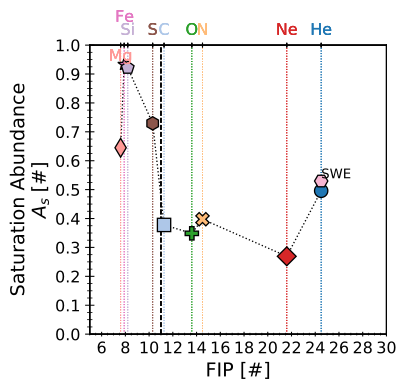
A scatter plot shows each element's abundance at the transition speed, plotted against its first ionization potential. The horizontal axis spans 6 to 30 eV; the vertical axis spans 0 to 1.0. A vertical black dashed line at 11 eV divides low-FIP from high-FIP elements. Low-FIP elements on the left reach high abundances: iron (dark star) and silicon (purple pentagon) near 0.93, sulfur (brown hexagon) near 0.73, and magnesium (pink diamond) near 0.65. High-FIP elements on the right sit lower: nitrogen (orange X) near 0.40, carbon (blue square) near 0.38, oxygen (green plus) near 0.35, and neon (red diamond) near 0.27. Helium appears at the far right with SWICS near 0.50 and SWE near 0.53. A dotted black line connects the points.
The Finding
The roughly two-fold enhancement of low-FIP elements over high-FIP elements at the fast-slow transition point matches the well-established FIP effect pattern. This confirms that the transition abundances reflect genuine solar composition signatures set in the chromosphere, not artifacts of the bilinear fitting method. Sulfur behaving like a low-FIP element is consistent with independent observations from suprathermal ion measurements.
Why It Matters
This figure serves as a critical consistency check for the entire analysis. If the bilinear fitting produced spurious transition points, the resulting abundances would not reproduce the well-known FIP (first ionization potential) pattern. Finding the expected step in abundances across the FIP boundary validates the analytical framework and gives confidence that the transition speeds and abundances identified throughout the paper reflect real physical boundaries in the solar wind, not statistical artifacts.
Appears In
aa51550-24 · fig 5