




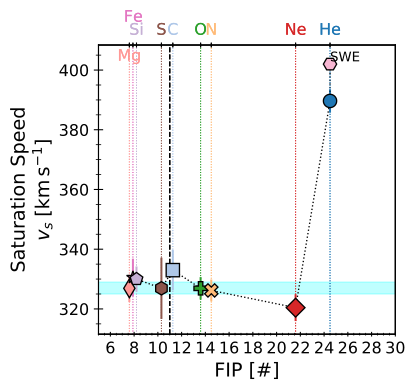
Transition speed does not depend on ionization energy
What We See
A scatter plot shows each element's transition speed plotted against its first ionization potential, the energy needed to strip its outermost electron. The horizontal axis spans 6 to 30 electron volts; the vertical axis spans 320 to 400 km/s. A vertical black dashed line at 11 eV separates low-FIP elements on the left from high-FIP elements on the right. A broad horizontal cyan band at 327 km/s marks the weighted average transition speed for heavy elements. Most data points cluster within this band. Helium stands apart at the far right, with its SWICS measurement (blue circle) near 390 km/s and its SWE measurement (pink hexagon) near 402 km/s. Element names appear along the top axis in matching colors.
The Finding
The fast-slow transition speed is essentially the same for all heavy elements regardless of how easily they are ionized. This independence from ionization energy means the transition is not driven by the chromospheric FIP effect, the well-known process that fractionates elements based on their first ionization potential. The responsible process must operate higher in the solar atmosphere, above where ionization-dependent fractionation occurs. Helium remains the clear outlier, transitioning at a markedly higher speed.
Why It Matters
By ruling out the FIP (first ionization potential) effect as the driver of the fast-slow transition, this figure narrows down where in the Sun's atmosphere the boundary between wind types is established. The responsible mechanism must operate above the chromosphere, where all elements are already fully ionized. This constraint helps solar physicists focus their models on the correct altitude range and physical processes when seeking to understand what separates fast and slow solar wind.
Appears In
aa51550-24 · fig 4