



Heavy ions transition to fast wind 75 km/s slower than helium
What We See
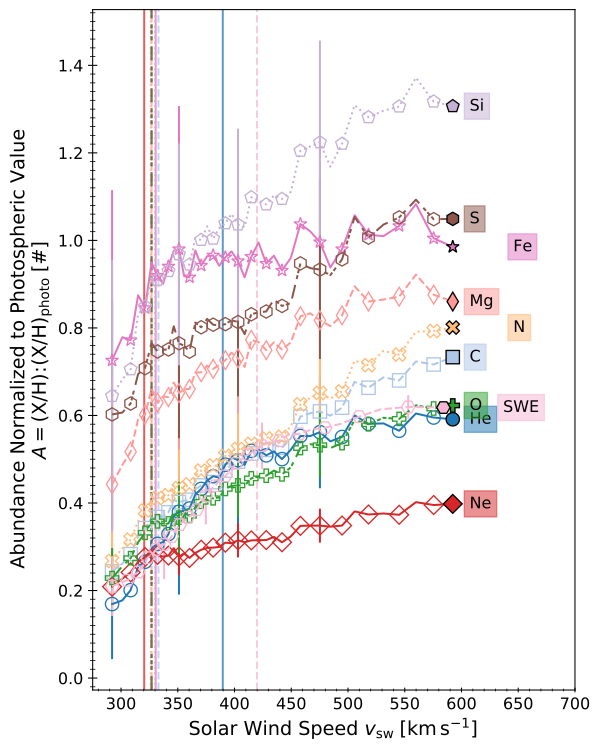
Ten colored curves track the photospheric-normalized abundance of different chemical elements against solar wind speed, spanning roughly 300 to 650 km/s. Each species has a unique color and marker shape: silicon (purple pentagons) and iron (pink stars) reach the highest values while neon (red diamonds) and helium (blue circles) sit lowest. Semitransparent vertical lines in each species' color mark the speed where its bilinear fit changes slope. For elements heavier than helium these lines cluster near 327 km/s, while the helium lines sit to the right near 390 to 402 km/s. Species labels appear at the right edge.
The Finding
Every element follows the same two-regime pattern: a steep rise at lower speeds and a shallower trend at higher speeds. The speed at which this transition occurs differs between helium and heavier elements. All elements heavier than helium transition near 327 km/s on average, about 63 km/s slower than helium's 390 km/s as measured by the same instrument. This gap shows that helium and heavier elements respond differently to whatever process separates fast from slow solar wind.
Why It Matters
If scientists use helium or the traditional 400 to 600 km/s range to separate fast from slow wind, they inadvertently mix solar wind from polar coronal holes with wind from equatorial sources that have intermittently open magnetic fields. Heavier elements place the true boundary lower, with direct consequences for correctly tracing the solar wind back to its origin on the Sun and understanding how different source regions contribute.
Appears In
aa51550-24 · fig 2