




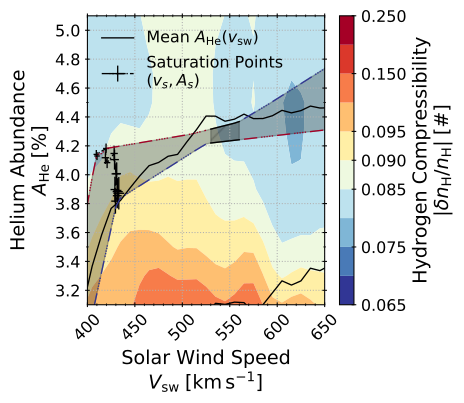
Compressibility contour gradient reverses at saturation
What We See
This chart zooms into the helium-speed saturation region, showing compressibility contours near the point where helium abundance stops rising with speed. The contour at the 0.09 level changes slope as it crosses the saturation points marked by black crosses. Solid black lines bound a narrow speed range of 530 to 560 km/s where helium fits at different wave activity levels cross over. This crossover region coincides with the 0.085 compressibility contour, and two separate pockets of compressibility below 0.085 are visible on either side of the saturation zone.
The Finding
At the saturation point, the compressibility contour gradient reverses direction. Below saturation, constant-compressibility contours follow increasing helium and speed together. Above saturation, they tilt so that wind with slightly more helium than the saturation value has noticeably different compressibility. The 0.085 compressibility level emerges as a natural boundary that intersects the crossover region where wave-activity-based fits switch dominance, linking two previously independent threshold values.
Why It Matters
This zoomed view provides detailed evidence that the saturation point corresponds to a real physical transition in the solar wind's density fluctuation behavior, not just a statistical convenience. The gradient reversal connects helium composition, which is set deep in the Sun's atmosphere, to the compressibility of fluctuations that evolve during interplanetary transit, linking two previously independent aspects of solar wind physics.
Appears In
Alterman 2026 ApJL 996 L12 · fig 8