



Wave activity maps onto the helium-speed plane
What We See
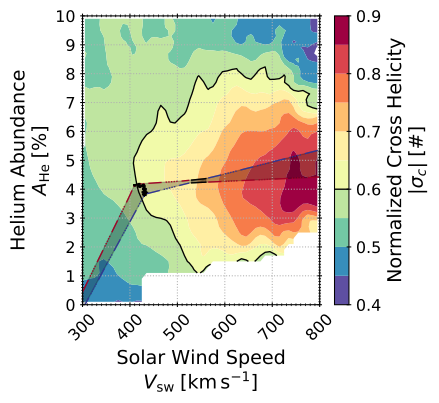
This contour plot shows the average wave activity level (color) as a function of solar wind speed (horizontal axis) and helium abundance (vertical axis). Warm reds indicate high wave activity; cool blues indicate low. Black points mark saturation points for different wave activity levels, all falling above the 0.6 contour highlighted in black. A shaded region bounded by colored dashed lines shows the envelope of helium-speed fits across wave activity quantiles, and solid black lines bound a narrow 530 to 560 km/s crossover speed range.
The Finding
The saturation points consistently fall in the region of moderately high wave activity, above the 0.6 contour. The envelope of helium-speed fits spans a narrow speed range of 530 to 560 km/s where fits at low and high wave activity cross over. This crossover is the speed at which non-Alfvenic wind begins to carry more helium than wave-dominated wind at the same speed. This creates an apparent paradox: wind from supposedly intermittent sources carrying more helium than wind from open sources.
Why It Matters
This figure connects the paper's three key variables in a single view. By showing that saturation points cluster in wave-rich territory and that low-wave-activity fits eventually exceed high-wave-activity fits, it demonstrates that something beyond wave activity determines helium behavior at high speeds. That something, the paper argues, is hydrogen compressibility. Resolving this paradox is the central goal of the subsequent analysis.
Appears In
Alterman 2026 ApJL 996 L12 · fig 6