




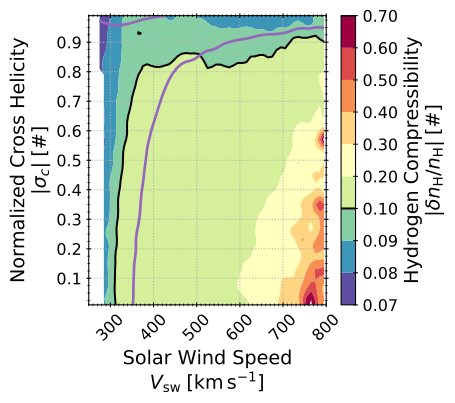
Compressibility and wave activity are inversely related
What We See
This contour plot maps the average hydrogen density fluctuation level using color across solar wind speed (horizontal axis) and wave activity (vertical axis). Cooler blues indicate low compressibility where density stays steady, while warmer yellows and oranges indicate high compressibility. A purple curve from a previous figure marks the 0.7 wave activity contour. A black contour at 0.1 separates compressible from incompressible regimes. Below the purple boundary, compressibility is generally high. Above it, compressibility is low, especially at high speeds.
The Finding
Compressibility and wave activity are inversely related across the speed-wave activity plane. The most compressible solar wind has low wave activity regardless of speed, while the most incompressible wind has high wave activity. The purple 0.7 contour from the wave activity distribution closely tracks the boundary between compressible and incompressible regions. This anticorrelation is most prominent at high speeds and virtually absent at low speeds, because compressible and incompressible wind overlap in the same speed range at lower speeds.
Why It Matters
By mapping compressibility onto the speed-wave activity plane, this figure demonstrates that compressibility provides independent information beyond what wave activity alone reveals. The distinct spatial patterns enable the authors to separate solar wind genuinely from open magnetic sources (incompressible, wave-rich) from wind carrying compressible fluctuations of potentially different origin. This sets up the quantitative analysis that follows.
Appears In
Alterman 2026 ApJL 996 L12 · fig 5