




Hydrogen density fluctuations persist across all speeds
What We See
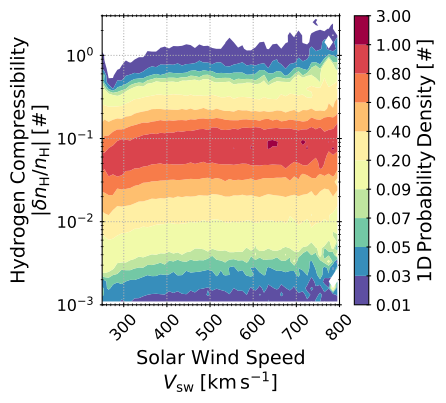
This contour plot shows how much the hydrogen density fluctuates (vertical axis, logarithmic scale) at each solar wind speed (horizontal axis). Brighter regions indicate more common combinations. At slow speeds, the fluctuations cluster around moderate values near 0.05 to 0.1. As speed increases past about 400 km/s, the most common fluctuation level decreases into the incompressible regime below 0.05, but a tail of large fluctuations extends upward at all speeds, including the fastest.
The Finding
Hydrogen compressibility changes systematically with solar wind speed. Slow wind shows a relatively narrow range of moderate compressibility. Fast wind is typically less compressible, consistent with wave-dominated wind where density stays relatively steady. However, a population of highly compressible fast wind persists, creating an asymmetric tail. These compressible fluctuations above 0.1 are present across all speeds, which is the key to explaining helium anomalies in fast wind.
Why It Matters
This figure introduces the paper's central innovation: hydrogen compressibility as a third classification variable. While previous work classified solar wind using speed and wave activity, this paper shows that density fluctuations carry independent information about the wind's origin. The coexistence of compressible and incompressible fast wind at the same speed is the first hint that speed alone cannot distinguish different types of fast solar wind.
Appears In
Alterman 2026 ApJL 996 L12 · fig 4