



Alfvenic wave activity concentrates in faster wind
What We See
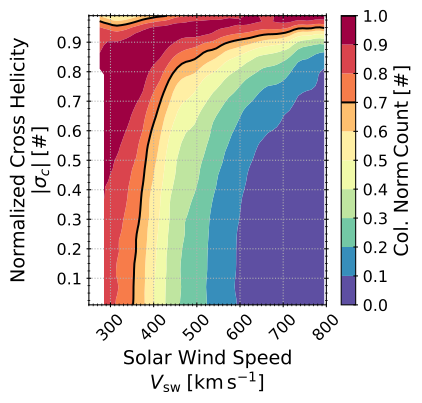
This contour plot shows how the normalized cross helicity, a measure of Alfvenic wave activity (vertical axis), varies with solar wind speed (horizontal axis). Brighter contour levels indicate more common combinations. A black contour at the 0.7 level marks a reference boundary. At slow speeds, wave activity spans a wide range of values centered around 0.5. As speed increases, the distribution narrows and shifts upward toward 1.0, meaning faster wind is increasingly dominated by Alfvenic magnetic wave oscillations.
The Finding
The solar wind becomes increasingly Alfvenic as speed rises. Wind with cross helicity above 0.7 predominantly originates from regions of the Sun that are continuously open to space, while lower cross helicity indicates more complex or mixed origins. This baseline trend sets up the paper's key question: if fast wind should be wave-rich, why does some fast wind carry unexpectedly low wave activity and anomalous helium levels?
Why It Matters
This figure establishes the baseline relationship between wave activity and speed that underpins the entire analysis. By showing that faster wind is typically more Alfvenic, it provides context for the central puzzle: compressible density fluctuations that the cross helicity alone cannot capture turn out to explain why some fast wind deviates from this expected trend. Understanding these deviations matters for correctly identifying where the solar wind originates on the Sun.
Appears In
Alterman 2026 ApJL 996 L12 · fig 2