




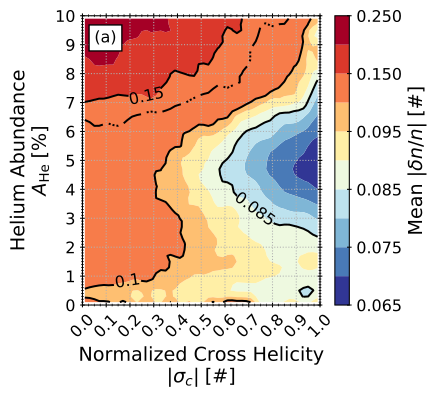
Mean compressibility concentrates at high helium, low wave activity
What We See
This panel maps mean hydrogen compressibility (color) across wave activity (horizontal axis) and helium abundance (vertical axis). The highest mean compressibility (warm colors, above 0.15) concentrates at upper left where helium is above about 7 percent and wave activity is below 0.5. The lowest compressibility (cool blues, below 0.085) fills the lower right where wave activity exceeds 0.6. Three solid black contours mark mean compressibility thresholds at 0.085, 0.1, and 0.15. A dashed contour shows where the 75th percentile reaches 0.15.
The Finding
Compressible fluctuations concentrate in the region of high helium and low wave activity, precisely the ambiguous zone that the companion paper's classification could not resolve. The 0.15 compressibility contour closely follows the boundary of this problematic region. Above the blue dashed line marking the continuously open source boundary, mean compressibility drops sharply below 0.085 regardless of helium level. This confirms that helium-rich, wave-poor wind is characterized by compressible fluctuations.
Why It Matters
This panel closes the loop between the companion paper's classification and this paper's compressibility analysis. The mysterious upper-left region with high helium and low wave activity is now identified as compressible wind. This resolves the companion paper's hypothesis about transients by providing the physical mechanism: compressible density fluctuations enhance helium independently of wave-driven processes in open-source wind.
Appears In
Alterman 2026 ApJL 996 L12 · fig 17a