




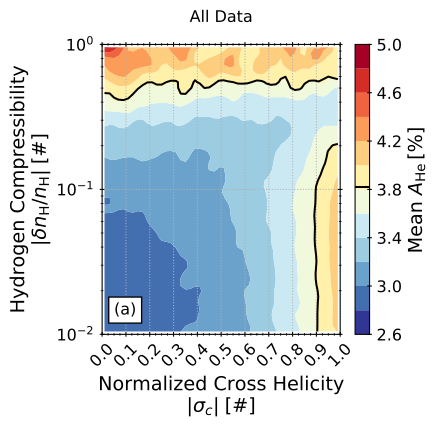
Mean helium reveals two distinct high-helium islands
What We See
This panel maps mean helium abundance (color) across wave activity (horizontal axis) and hydrogen compressibility (vertical axis, logarithmic). Two separate warm-colored high-helium islands are visible: one at high wave activity with low compressibility (lower right), and another at high compressibility regardless of wave activity (top). A black contour marks the minimum saturation abundance of 3.82 percent. Between these two islands, mean helium is lower and relatively uniform, forming the helium-poor bulk of the solar wind.
The Finding
Enhanced mean helium above saturation exists in two physically separated regions. The Alfvenic island at lower right has high wave activity, low compressibility, and uniformly elevated helium consistent with steady open-source fast wind. The compressible island at top has high compressibility across all wave activity levels and comparable mean helium, but reaches these values through a fundamentally different mechanism. Between the islands, helium stays below the minimum saturation abundance.
Why It Matters
This panel establishes the central visual finding of the paper: two distinct populations of helium-rich solar wind exist in fluctuation parameter space. The mean values alone might suggest these populations are equivalent, but the companion panels revealing the 90th percentile, 10th percentile, and variability will show they differ dramatically in their statistical character, pointing to entirely different physical origins.
Appears In
Alterman 2026 ApJL 996 L12 · fig 15a