




Excluding compressible wind flattens the wave-activity dependence
What We See
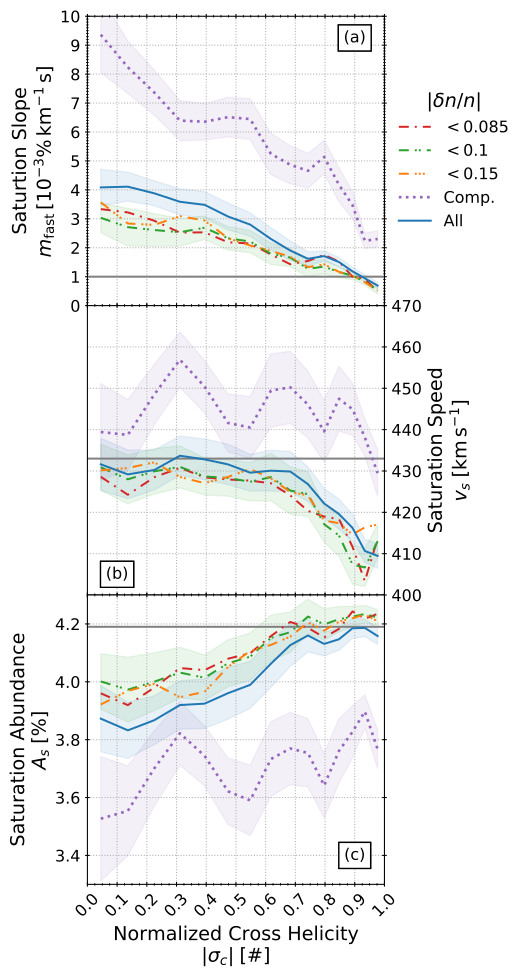
Three panels show saturation fit parameters plotted against wave activity, each with multiple colored curves representing different upper limits on allowed compressibility (red for 0.085, green for 0.1, orange for 0.15) plus a purple curve for the compressible subset above 0.15. A blue curve shows all data. Gray horizontal lines mark the overall values ignoring compressibility. Panel (a) shows the saturation slope, panel (b) the saturation speed, and panel (c) the saturation abundance. As compressible wind is progressively excluded, the colored curves converge and flatten.
The Finding
When compressible wind is progressively excluded, the dependence of saturation parameters on wave activity diminishes substantially. All saturation slopes still decrease with increasing wave activity, but excluding compressible wind reduces the slopes and brings incompressible subsets into closer agreement, with the largest reduction at low wave activity. Compressible saturation speed is less than 10 percent larger than incompressible values. Compressible saturation abundance is at most 16 percent smaller. This demonstrates that the companion paper's observation of strongly wave-activity-dependent saturation was substantially driven by the inclusion of compressible fluctuations.
Why It Matters
This figure resolves the central puzzle from the companion paper. What appeared to be a wave-activity effect on helium saturation was actually a compressibility effect correlated with wave activity. This distinction matters for solar wind modeling: helium behavior can be predicted from density fluctuation measurements without needing to first classify the wind by wave activity, simplifying the observational requirements.
Appears In
Alterman 2026 ApJL 996 L12 · fig 13