




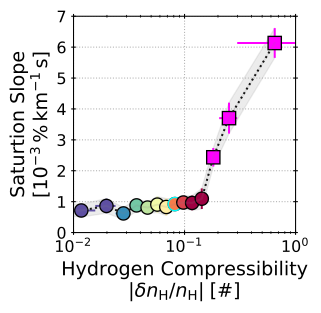
Compressible wind has six times steeper helium gradients
What We See
This scatter plot shows the slope of the helium-speed relationship above saturation (vertical axis) versus hydrogen compressibility (horizontal axis). Circular markers represent incompressible wind (below 0.15), while pink squares represent compressible wind (above 0.15). Error bars indicate uncertainties. The incompressible points cluster near zero slope at roughly 0.001 percent per km/s. The compressible points jump dramatically to slopes five to six times larger, with the steepest value of about 0.006 at the highest compressibility.
The Finding
The helium gradient above saturation is nearly zero for incompressible wind, consistent with the expected flat plateau from open-source fast wind, but increases sharply for compressible wind. The transition occurs abruptly near the 0.15 compressibility threshold. This confirms that the large helium gradients identified in the companion paper's low-wave-activity analysis were driven specifically by compressible fluctuations rather than by low wave activity itself.
Why It Matters
This figure provides the clearest quantitative evidence that compressible fluctuations cause anomalous helium behavior in fast wind. The sharp transition at 0.15 defines a practical threshold for separating two physically distinct solar wind populations, directly applicable in space weather analysis to distinguish genuinely open-source fast wind from compressibly enhanced wind that may originate from different solar sources.
Appears In
Alterman 2026 ApJL 996 L12 · fig 12