




Saturation speed and abundance shift at the compressibility boundary
What We See
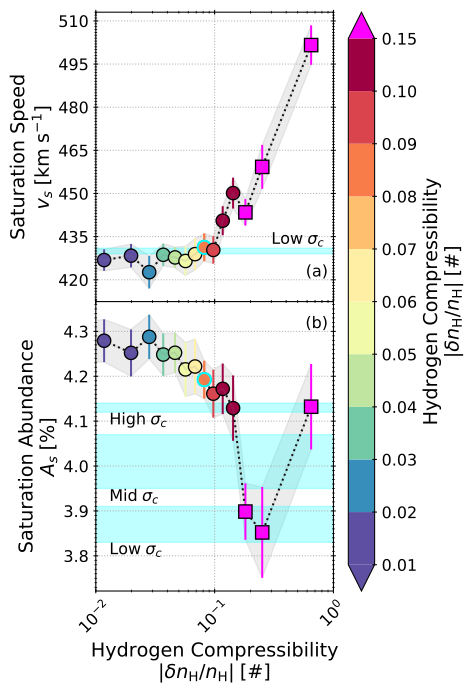
Two panels show how the saturation point changes with hydrogen compressibility (horizontal axis). Panel (a) shows saturation speed: approximately constant near 428 km/s for incompressible quantiles (circles, compressibility below 0.15), then stepping up markedly for compressible quantiles (pink squares) to a maximum of 502 km/s. Panel (b) shows saturation helium abundance: roughly constant near 4.2 percent for incompressible quantiles, but non-monotonic in the compressible subset, dropping to 3.9 percent before rising to 4.13 percent at the highest compressibility. Cyan bands mark wave-activity intervals from the companion paper.
The Finding
Saturation speed increases with compressibility, stepping up sharply at the incompressible-compressible boundary near 0.15. Saturation helium abundance is approximately constant in incompressible wind but non-monotonic in compressible wind, first decreasing to a local minimum before rising at the highest compressibility. The 0.085 compressibility level (blue-edged marker) emerges as a transition between regimes, mirroring the pattern found across wave activity levels in the companion paper.
Why It Matters
This figure quantifies how the slow-to-fast wind transition depends on compressibility and provides the numerical foundation for mapping between the companion paper's wave-activity results and this paper's compressibility results. The systematic shift of the saturation point challenges the traditional view of a single dividing speed between slow and fast solar wind and suggests the transition depends on fluctuation properties.
Appears In
Alterman 2026 ApJL 996 L12 · fig 11