




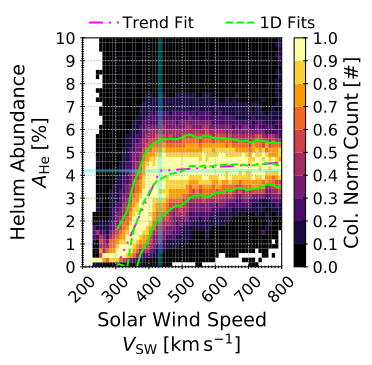
Helium abundance saturates at 4.19% above 433 km/s
What We See
A column-normalized density map shows helium abundance (vertical axis, 0-10%) versus solar wind speed (horizontal axis, 200-800 km/s). Yellow indicates the most common helium value at each speed; dark purple indicates rare values. A green dashed line traces the mean helium at each speed, bounded by solid green uncertainty lines. A pink dash-dot two-segment fit overlaps the green curve. A vertical cyan line at 433 km/s and a horizontal cyan line at 4.19% mark the saturation point. Below 433 km/s, helium rises steeply from near zero; above it, helium flattens near 4.19%.
The Finding
Helium abundance undergoes a sharp transition at 433 km/s. Below this speed, helium increases steeply with speed from nearly zero, reflecting conditions in magnetically closed source regions where helium struggles to escape the Sun's gravitational pull. Above this speed, helium saturates at 4.19%, indicating wind from magnetically open regions where helium is freely accelerated alongside hydrogen. This saturation speed provides a physically motivated boundary between wind from closed and open magnetic sources, replacing the traditionally arbitrary fast/slow speed threshold.
Why It Matters
Identifying a physically grounded threshold at 433 km/s rather than an arbitrary speed cutoff enables more accurate classification of the solar wind's origin. This saturation speed is measurable with standard plasma instruments aboard most heliophysics spacecraft. It also establishes the baseline against which the paper then examines how wave activity further modifies this boundary, revealing the origin of the Alfvenic slow wind in subsequent figures.
Appears In
Alterman 2025 ApJL 982 L40 · fig 3