




Mean speed in the helium-wave plane reveals two source populations
What We See
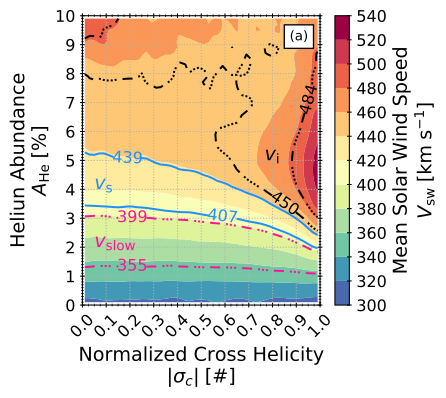
A filled contour map shows mean solar wind speed (color scale 300-540 km/s) as a function of wave activity (horizontal axis, 0-1) and helium abundance (vertical axis, 0-10%). Cool blue-green colors indicate slow wind; warm orange-red colors indicate fast wind. Pink dash-dot contour pairs labeled 355 and 399 km/s mark the slow wind peak range. Solid blue contours labeled 407 and 439 km/s bound the saturation speed range. Black dash-dot contours labeled 450 and 484 km/s mark the Gaussian intersection range. Below the saturation contours, cool colors span all wave activities. Above 460 km/s, warm colors appear only at high wave activity (above 0.73) on the right side of the plane.
The Finding
Two distinct populations emerge in the combined helium-wave activity space. Solar wind from closed magnetic sources occupies the lower portion of the plane (low helium, any wave activity) with mean speeds below the saturation threshold. Solar wind from open magnetic sources clusters at high wave activity (above 0.73) and moderate-to-high helium (above 2.6%) with faster mean speeds. Between these populations lies a transition zone where both source types mix. This two-dimensional separation is far cleaner than any single-parameter classification based on speed alone.
Why It Matters
This panel demonstrates the paper's central practical result: combining helium abundance and wave activity creates a classification space that separates solar wind sources more effectively than speed. The contour structure reveals why a single speed threshold fails -- at any speed in the transition zone (407-484 km/s), wind from both open and closed sources is present. Critically, this classification requires only standard plasma instruments, not a mass spectrometer, making it applicable to nearly all heliophysics missions.
Appears In
Alterman 2025 ApJL 982 L40 · fig 10a