




Spectral slope holds steady as sunspot activity rises and falls
What We See
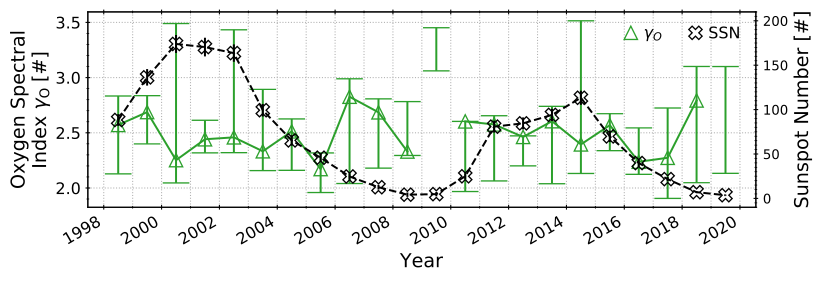
A dual-axis time-series plot spanning 1998 to about 2020. Green open triangles connected by a solid green line track the oxygen spectral index on the left axis, which ranges from about 2.0 to 3.5. Vertical green error bars on each triangle extend from the shallowest to the steepest spectral slope measured across all nine heavy-ion species that year, showing the species-to-species spread. Black crossed symbols connected by a dashed black curve trace the annual sunspot number on the right axis, which ranges from 0 to 200. The sunspot curve sweeps through two full peaks (near 2001 and 2014) and two deep minima (around 2008-2009 and 2018-2019). Some years near solar minimum lack a green triangle because particle counts were too low for a reliable spectral fit.
The Finding
Over more than two decades, the oxygen spectral slope fluctuates around a value of roughly 2.5 without tracking the dramatic swings in sunspot activity. When the Sun is stormy and sunspots peak, the slope stays near 2.5; when the Sun is quiet and sunspots vanish, it still hovers near 2.5. The range spanned by other species each year (the error bars) is comparable to the year-to-year scatter in oxygen itself. Statistical tests confirm that only two of the nine elements show even a modest correlation with sunspot number, and none shows a strong one.
Why It Matters
The independence of spectral slope from solar activity is a striking observational constraint. The dominant sources of suprathermal particles shift with the solar cycle: storm-driven shocks dominate at solar maximum, and corotating interaction regions take over during solar minimum. Yet the combined imprint of acceleration and interplanetary transport produces a spectral shape that barely changes. This stability supports the picture that quiet-time suprathermals are a well-mixed reservoir of remnants from many past events, not the direct output of whichever process happens to be most active at the time.
Appears In
Alterman 2024 ApJL 964 L31 · fig 2