




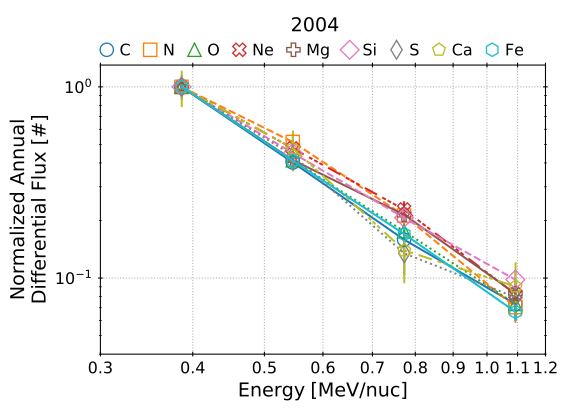
Nine heavy-ion species fall along identical power-law spectra
What We See
A log-log plot titled '2004' shows how particle intensity drops with increasing energy for nine chemical elements measured during quiet periods. The horizontal axis marks energy from 0.3 to about 1.2 MeV per nucleon; the vertical axis shows the normalized annual differential flux spanning roughly one and a half decades. Each element carries a distinct color and marker: carbon (blue circles), nitrogen (orange squares), oxygen (green triangles), neon (red crossed circles), magnesium (brown plus signs), silicon (pink diamonds), sulfur (gray diamonds), calcium (yellow pentagons), and iron (cyan hexagons). Lines connect each species' data points. All nine traces start together at the top-left and slope downward in a tight, nearly parallel bundle toward the lower-right.
The Finding
Despite spanning a factor of nearly five in atomic mass — from carbon (mass 12) to iron (mass 56) — every element produces essentially the same spectral shape during quiet times. The spectra follow clean power laws across the full 0.3 to 1.28 MeV per nucleon energy range with no breaks or rollovers. Because different elements have different masses and electric charges, most acceleration mechanisms would treat them differently. The fact that all nine species are virtually interchangeable in spectral slope points to a process indifferent to the identity of the ion being accelerated or transported.
Why It Matters
Suprathermal ions occupy the energy gap between the everyday solar wind and the high-energy particles that endanger astronauts and satellites. They serve as the seed population that gets boosted to dangerous energies during solar storms. Finding that their energy spectrum looks the same regardless of element places a hard constraint on candidate acceleration theories: any viable explanation must reproduce a species-independent power law. This favors models where these particles are leftover remnants of past energetic events rather than products of a single continuously operating mechanism.
Appears In
Alterman 2024 ApJL 964 L31 · fig 1