




Suprathermal variability increases with mass-per-charge, matching GSEP trends
What We See
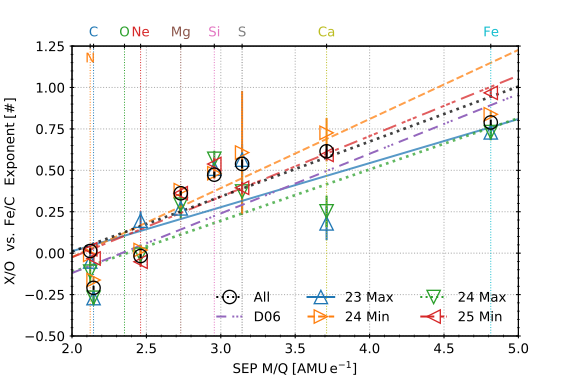
Power-law exponents from quiet-time abundance variability fits are plotted against SEP mass-per-charge ratio (M/Q) on the horizontal axis, with element labels along the top (C, N, O, Ne, Mg, Si, S, Ca, Fe). Each solar cycle period has its own colored markers and fitted trend line: blue triangles for cycle 23 maximum, orange right-pointing arrows for cycle 24 minimum, green inverted triangles for cycle 24 maximum, and red left-pointing arrows for cycle 25 minimum. Black circles with a dotted line show the all-data trend. A purple dashed line shows the equivalent trend from Desai et al. (2006) for individual gradual SEP events. All trend lines slope upward from left (low M/Q, near C) to right (high M/Q, near Fe), and their slopes cluster together despite covering different solar cycle phases.
The Finding
The variability of quiet-time suprathermal abundances increases systematically with mass-per-charge ratio across all solar cycle phases. Heavier elements like Fe (M/Q near 4.9) show much larger abundance swings than lighter elements like C (M/Q near 2.0). The slopes of these trends are consistent with those measured by Desai et al. (2006) in individual gradual SEP events, despite being derived from an entirely different dataset spanning two decades of quiet-time observations. This match strongly supports the interpretation that gradual SEP events accelerate ions drawn from this preexisting suprathermal pool.
Why It Matters
The agreement between quiet-time suprathermal variability and individual GSEP (gradual solar energetic particle) event variability is a key piece of evidence linking the two populations. If gradual SEP events accelerate a preexisting suprathermal seed pool, the mass-dependent variability in the seed should propagate into the accelerated population, and it does. This connection enables predictions of future energetic particle event composition based on ambient suprathermal conditions, which has practical implications for forecasting space radiation hazards.
Appears In
Alterman 2023 ApJ 952 42 · fig 8