




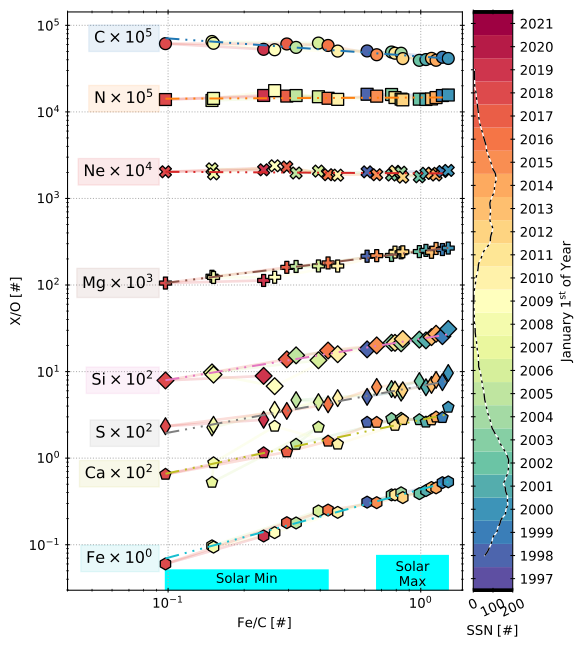
All heavy ion abundances follow power-law trends with Fe/C ratio
What We See
A log-log plot shows eight heavy element abundances (C through Fe, vertically offset by labeled scale factors) plotted against the iron-to-carbon ratio. Each annual data point is color-coded by year using a color bar on the right, where dark purple represents 1997, yellow-green represents the late 2000s, and dark red represents 2021. A sunspot number curve runs alongside the color bar. Translucent line segments connect successive years, creating looping paths that track each element's trajectory through time. Dash-dotted power-law fit lines thread through each species' data. Cyan and pink shaded boxes at the bottom label the Fe/C ranges corresponding to solar minimum (low Fe/C, left) and solar maximum (high Fe/C, right).
The Finding
Fe/C serves as a sensitive single-number indicator of the overall heavy-ion enrichment state in quiet-time suprathermals. All elements except carbon show positive power-law trends with Fe/C: when iron-to-carbon is high (solar maximum), all heavy elements are enriched relative to oxygen; when it is low (solar minimum), they are depleted. Carbon shows the reverse trend. The data points trace cyclic loops rather than scattering randomly, revealing that the composition follows a path tied to the phase of solar activity rather than simply oscillating between two fixed states.
Why It Matters
Reducing the complex behavior of eight elements to power-law relationships with a single enrichment indicator (Fe/C) provides a compact framework for characterizing the suprathermal seed population's state at any time. The cyclic looping pattern confirms that composition changes are driven by the solar cycle's progression through different source-population regimes, not by random event-to-event fluctuations. This framework enables quantitative predictions of how each element's abundance will vary as solar activity rises and falls.
Appears In
Alterman 2023 ApJ 952 42 · fig 6