




Quiet-time thresholds remain consistent across two solar cycles
What We See
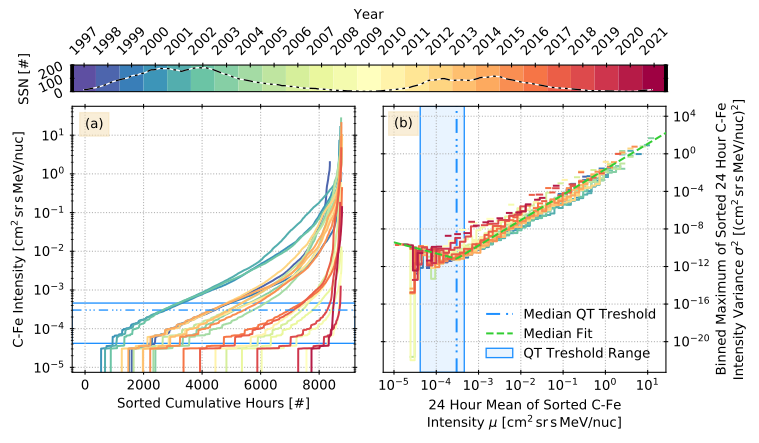
A color bar at the top maps years from 1997 (dark blue-purple) through 2021 (dark red), with a dashed black curve showing 13-month smoothed sunspot number peaking around 2000 and 2014. Below, panel (a) overlays the sorted cumulative intensity curves from every year, each colored by its year. The curves fan out at higher cumulative hours, with solar-maximum years (warm colors) reaching higher intensities. Horizontal blue lines bracket the range of quiet-time thresholds. Panel (b) overlays all years' variance-mean curves, which converge into a tight band at high intensities. A vertical light-blue shaded band marks the range of QT thresholds, a blue dash-dotted line marks the median threshold, and a green dashed line traces the median fit across all years.
The Finding
Despite spanning two complete solar cycles with dramatically different activity levels, the quiet-time thresholds cluster within a narrow range. The variance-mean relationship follows the same two-power-law shape every year, with only the low-intensity end shifting as background conditions change. All years' curves merge into a single tight band at high intensities. This consistency across 22 years confirms that the method captures a real physical transition between quiet and active conditions, not an artifact of any particular year's data.
Why It Matters
Establishing that the quiet-time identification method works consistently from 1997 to 2021 validates it as a reliable long-term tool. This consistency is critical because the scientific goal is tracking how quiet-time particle composition changes with solar activity. If the method itself introduced year-to-year variations, those artifacts would contaminate the composition signal being studied. The narrow threshold range ensures that downstream abundance measurements reflect real physical changes, not methodological drift.
Appears In
Alterman 2023 ApJ 952 42 · fig 2