




Faster solar wind waits longer to respond to solar activity
What We See
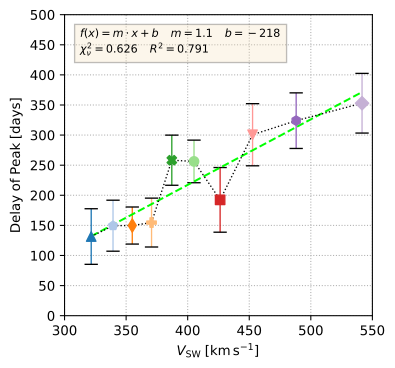
Colored data points with error bars march upward from left to right across the plot, showing the time delay in days between a change in sunspot number and the corresponding change in helium abundance. A blue triangle at the slowest speed (322 km/s) sits near 130 days; a lavender diamond at the fastest speed (542 km/s) reaches about 350 days. A green dashed line shows the linear fit threading through the data. A text box in the upper left gives the fit equation (delay = 1.1 times speed minus 218 days, with R-squared of 0.791). Error bars are sizable, reflecting genuine scatter, but the upward trend is unmistakable. A red square near 426 km/s dips below the trend at roughly 190 days.
The Finding
The delay between solar activity and helium's response increases at a rate of about 1.1 days per additional kilometer per second of wind speed. Extrapolating the linear fit to zero delay yields a speed of 200 km/s, which falls below the 259 km/s threshold where helium vanishes from the solar wind entirely. This means that every bit of helium observed in the solar wind necessarily responds to solar activity changes after some minimum delay, estimated at about 68 days or roughly two solar rotations. The scatter also hints at two possible groupings: a plateau near 150 days for slow wind and a jump above 300 days for faster wind.
Why It Matters
The delay between solar activity changes and helium's response increases steadily with wind speed. The 150-day delay in slow wind matches the known lag of chromospheric and transition-region indicators, while the 300-plus-day delay in faster wind aligns with coronal indicators like soft X-rays from active regions. This correspondence suggests that slow and fast solar wind originate from physically distinct regions of the Sun's atmosphere that process and release helium on different timescales, providing a new diagnostic tool for identifying solar wind source regions.
Appears In
Alterman 2019 ApJL 879 L6 · fig 2b