




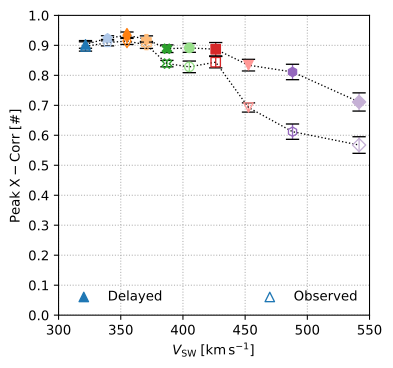
Delaying sunspot number lifts the helium correlation at all speeds
What We See
Two series of colored data points trace the strength of the helium-sunspot connection at each wind speed. Empty markers (observed) and filled markers (delayed) share the same color and shape scheme from Figure 1, connected by dotted lines to guide the eye. At the slowest speeds on the left, both series cluster tightly between 0.89 and 0.95. Moving rightward to faster speeds, the empty markers plunge from about 0.84 down to 0.57, while the filled markers hold above 0.7 across the entire range. Error bars on each point are small, confirming that the separation between the two series is robust.
The Finding
Accounting for the time delay between solar activity changes and helium's response dramatically improves the helium-sunspot correlation, especially in faster wind. In the fastest bin, the correlation jumps from 0.57 to above 0.7 once the delay is applied. In slower wind the improvement is smaller in absolute terms but statistically more meaningful because the already-high correlation moves closer to its ceiling. Both the observed and delayed series peak at the same wind speed (355 km/s), confirming that the delay correction does not shift which speed is most strongly coupled to solar activity.
Why It Matters
Previous studies found that the helium-sunspot connection weakened and nearly disappeared in faster wind, suggesting it might be a purely slow-wind phenomenon. This panel overturns that conclusion: once the delay is properly accounted for, helium is strongly correlated with sunspots at all speeds observed. This reveals that a single underlying relationship governs helium's response to solar activity across the slow and intermediate-speed solar wind.
Appears In
Alterman 2019 ApJL 879 L6 · fig 2a