




Alpha-to-beam speed ratio sharpens in youngest plasma
What We See
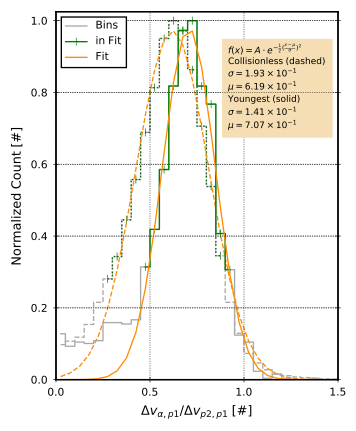
Two overlapping histogram distributions plot the ratio of alpha particle drift speed to proton beam drift speed on the horizontal axis against normalized count on the vertical axis. Gray stepped lines show all binned data for each subset. The dashed green histogram with its dashed orange Gaussian fit represents the broader low-collision sample, peaking near 0.62. The solid green histogram with its solid orange fit represents only the very youngest plasma, peaking near 0.71. An inset text box at upper right gives the Gaussian fit parameters for both subsets. The solid (youngest) curve is visibly taller and narrower than the dashed (collisionless) curve.
The Finding
In the youngest, most collisionless solar wind measured at Earth, alpha particles drift at about 71% the speed of proton beams, compared to 62% when a broader range of weakly collisional data is included. The distribution narrows by about 27% in the youngest plasma. Because alpha drift decays with collisions but beam drift does not, restricting to the least collisional data recovers a ratio closer to the intrinsic value launched from the solar corona and removes the spread that collisional erosion introduces during transit.
Why It Matters
Pinpointing the intrinsic drift speed ratio -- what the Sun actually launches -- requires minimizing contamination from collisional processes during transit. The fact that restricting to the youngest plasma sharpens the distribution confirms that most of the observed variability in the drift ratio comes from collisions, not from variability at the source. This provides a cleaner observational target for theoretical models of coronal acceleration to match.
Appears In
Alterman 2018 ApJ 864 112 · fig 6