



Alpha drift fades with collisions while beam drift persists
What We See
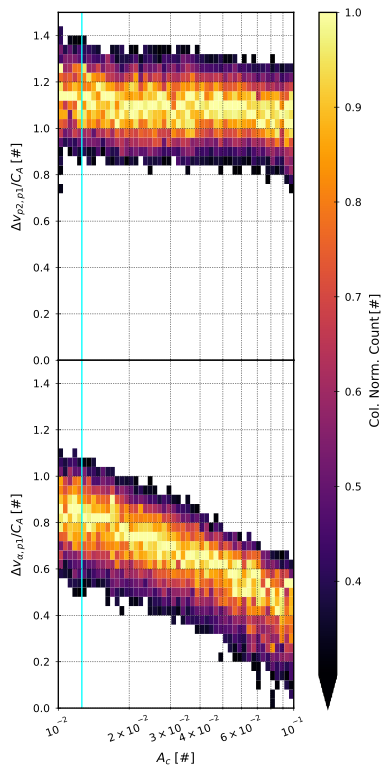
Two vertically stacked heatmaps share a horizontal axis of collisional age (ranging from 10^-2 to 10^-1 on a logarithmic scale). The top panel shows proton beam drift speed normalized by the Alfven speed, where a bright horizontal band of yellow and orange bins sits steadily between about 0.8 and 1.4, remaining flat across the full collisional age range. The bottom panel shows alpha particle drift speed, where the bright band slopes distinctly downward from about 0.8 at the youngest ages on the left to about 0.4 at the oldest ages on the right. A vertical cyan line near the left edge marks the boundary of the youngest measured subset at collisional age 1.2 x 10^-2. Colors range from dark purple at low column-normalized counts through orange and yellow at the highest.
The Finding
Alpha particle drift speed drops dramatically -- from about 80% to 40% of the Alfven speed -- as collisional age increases across the measured range. In stark contrast, proton beam drift remains essentially constant near the Alfven speed regardless of how many collisions have occurred. This asymmetry is surprising because both populations travel through the same plasma and experience the same collision environment, yet only the alpha drift is eroded by Coulomb friction.
Why It Matters
Coulomb collisions act as a friction force that should slow all drifting particles. The fact that proton beams resist this friction while alpha particles do not is a central puzzle of this study. Either some process continuously regenerates the beam drift (such as resonant interaction with Alfven waves), or the effective collision rate for beams is significantly lower than standard calculations predict. Resolving this dichotomy would fundamentally advance our understanding of how energy is partitioned among particle populations in the solar wind.
Appears In
Alterman 2018 ApJ 864 112 · fig 5