




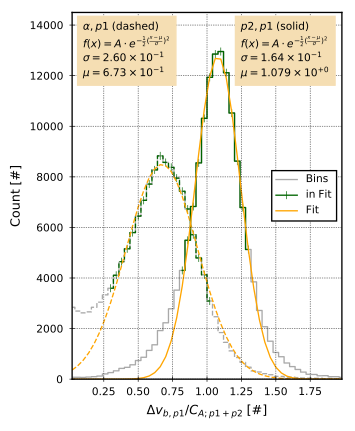
Proton beams drift faster than alphas relative to the Alfven speed
What We See
Two overlapping histogram distributions plot drift speed normalized by the Alfven speed on the horizontal axis against measurement count on the vertical axis. Gray stepped lines show all data for each population. The alpha particle distribution (dashed green with orange fit) is broader and peaks near 0.67, while the proton beam distribution (solid green with orange fit) is taller, narrower, and peaks near 1.08. Inset text boxes at the top give the Gaussian fit parameters: the alpha mean is 6.73 x 10^-1 with width 2.60 x 10^-1, while the beam mean is 1.079 x 10^0 with width 1.64 x 10^-1.
The Finding
In fast, nearly collisionless solar wind, proton beams consistently drift about 60% faster than alpha particles relative to the main proton population. The beam drift clusters tightly around the Alfven speed (108%), suggesting a magnetic wave process sets an upper limit. Alpha particle drift is both slower (67% of the Alfven speed) and more spread out, indicating that additional processes -- likely Coulomb collisions -- broaden the alpha distribution more than the beam distribution.
Why It Matters
The Alfven speed is the characteristic propagation speed of magnetic waves in the solar wind. That proton beams drift at nearly this speed while alpha particles drift at only two-thirds of it reveals that these two particle populations interact with the same magnetic environment in fundamentally different ways. This difference is key to explaining how the solar wind is heated and accelerated, because wave-particle interactions are thought to transfer energy from magnetic fluctuations to plasma particles.
Appears In
Alterman 2018 ApJ 864 112 · fig 3