



Turbulence
Placeholder — awaiting domain expert review
Placeholder — awaiting domain expert review
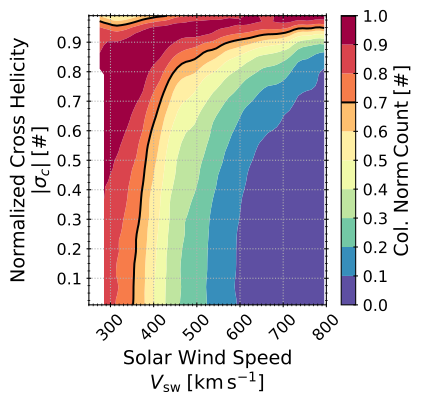
Alfvenic wave activity concentrates in faster wind
This contour plot shows how the normalized cross helicity, a measure of Alfvenic wave activity (vertical axis), varies with solar wind speed (horizontal axis). Brighter contour levels indicate more common combinations. A black contour at the 0.7 level marks a reference boundary. At slow speeds, wave activity spans a wide range of values centered around 0.5. As speed increases, the distribution narrows and shifts upward toward 1.0, meaning faster wind is increasingly dominated by Alfvenic magnetic wave oscillations.
normalized_cross_helicitysolar_wind_speedAlfvenicitywave_activitysource_regions
See Also
Source
Cross Helicity and the Helium Abundance as an In Situ Metric of Solar Wind Acceleration
The Astrophysical Journal Letters (2025)
View Paper© 2025 The Author(s). Published by the American Astronomical Society. CC BY 4.0