



New algorithm separates three ion populations in Faraday cup data
What We See
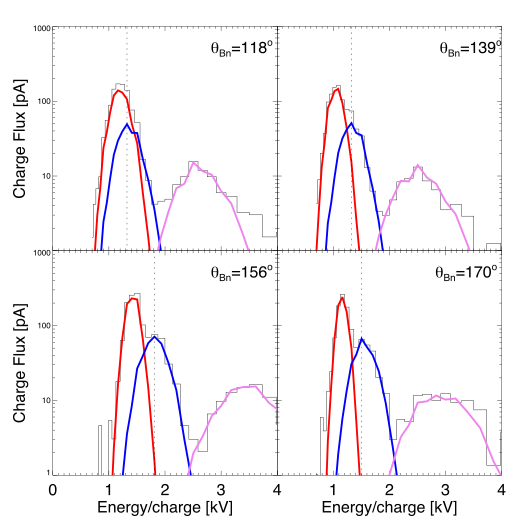
Four panels display energy spectra from the Wind spacecraft's Faraday cups, each measured from a different angle relative to the magnetic field (118, 139, 156, and 170 degrees, noted in each panel corner). Thin black stepped histograms show the raw measured charge flux on a logarithmic vertical axis versus energy-per-charge on the horizontal axis. Three colored curves overlay each histogram: a red peak for the main proton population, a blue peak at slightly higher energy for the proton beam, and a pink peak at even higher energy for alpha particles. A vertical black dashed line in each panel marks where the beam-to-core phase-space density ratio is evaluated. As the angle increases toward 170 degrees, the blue beam peak separates more clearly from the red core peak.
The Finding
A new data processing algorithm simultaneously detects and separates three distinct ion populations in the solar wind -- proton cores, proton beams, and alpha particles -- from a single set of Faraday cup measurements. The beam signature separates most clearly from the core at look directions most aligned with the magnetic field, appearing as a distinct blue bump at higher energy-per-charge than the red core peak. Applied to over 20 years of Wind spacecraft data, this three-population fitting enables the first large-scale simultaneous comparison of alpha particle and proton beam differential flows.
Why It Matters
Detecting the proton beam has historically been difficult because it overlaps with the main proton peak in energy. This improved fitting technique unlocks two decades of archived Wind data for proton beam studies, enabling statistical comparisons between ion populations that were previously limited to case studies or shorter time periods. Understanding how different particle populations move through the solar wind reveals how energy is transferred from magnetic waves to particles, a fundamental process in solar wind acceleration.
Appears In
Alterman 2018 ApJ 864 112 · fig 1